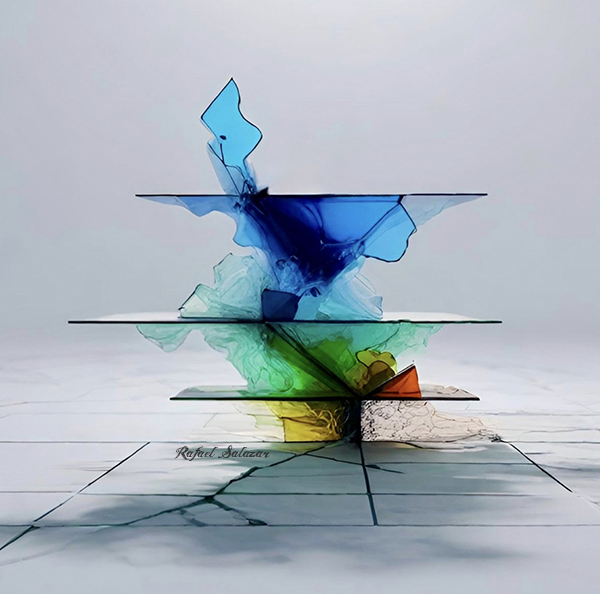

Founder of Motionalism | 82 Years Young
For more than six decades, Colombian born artist Rafael Salazar has explored the relationship between movement, emotion, memory and human transformation. It is an artistic journey that has continued to evolve throughout his life, responding to changing experiences, cultures and technologies without losing sight of the human emotions at its centre.
Today, at 82 years young, he continues that exploration through Motionalism, a contemporary artistic language centred on energy, silence, discernment and emotional motion.
“Motionalism™️ is not a style,” Salazar says. “It is a language.”
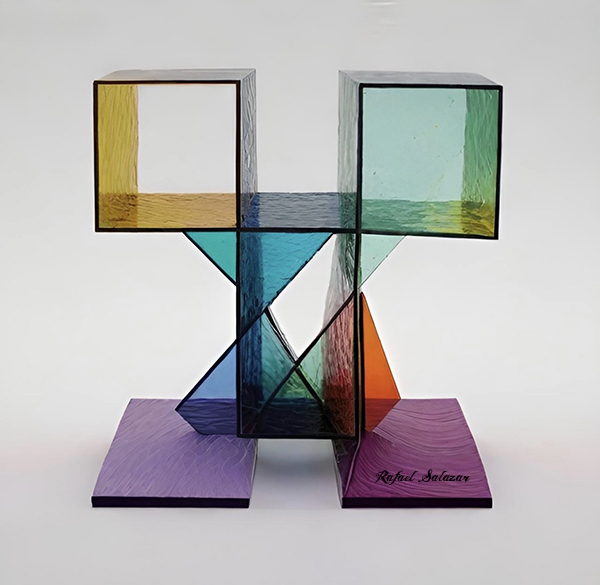
Transparent geometric volumes intersect through color and light, creating a delicate balance between architecture, openness, and visual movement.
Copyright 2026 – All rights reserved by Rafael Salazar.
Born in Colombia and shaped by a lifetime of global experiences across the Americas, Europe and Asia, Salazar’s artistic journey has evolved far beyond traditional definitions of painting or sculpture. His work bridges instinct, abstraction, digital experimentation, philosophy and emerging technologies, while remaining deeply centred on human emotion and the ways in which people experience and interpret the world around them.
Rather than allowing a particular medium to define the work, Salazar places the idea and the emotional response first. The tools may change, but the underlying search remains remarkably consistent.
At the core of Motionalism is a simple but profound idea: movement is not only physical. It can also be emotional, psychological, spiritual and internal.
“Motionalism is the moment where motion becomes emotion,” he explains. “The invisible movement inside the human being becomes visible through art.”
This concept allows movement to exist without necessarily depicting something physically moving. It might instead be found in a change of feeling, an emerging memory, a tension between forms or that difficult to define instant when one emotional state begins to become another.
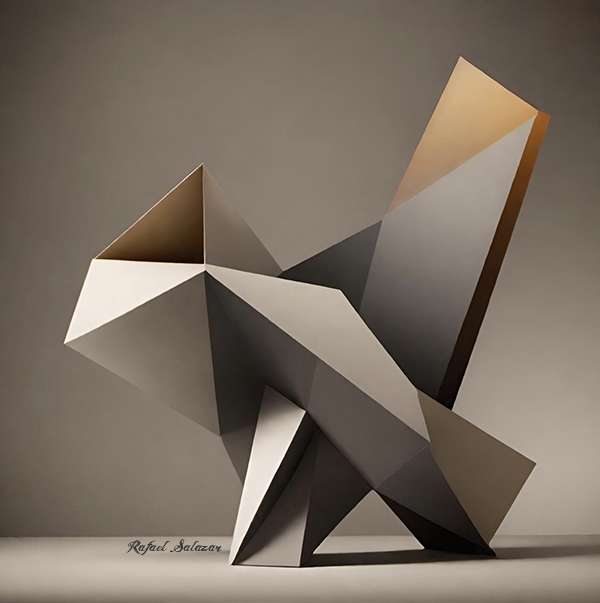
Angular planes intersect and counterbalance one another, turning apparent structural stability into an active experience of direction and force.
Copyright 2026 – All rights reserved by Rafael Salazar.
Rather than presenting literal subjects or prescribing a single interpretation, Salazar’s works often appear as luminous structures, energetic atmospheres, fragmented flows or suspended moments in transformation. Viewers may interpret the same piece in completely different ways, something he considers not merely acceptable, but essential to the movement itself.
“Only the observer possesses the message.”
For Salazar, the artwork is therefore never entirely complete until someone experiences it. The observer does not simply look at the work from the outside; they become part of its completion through personal memory, feeling and interpretation.
What one person recognises as serenity, another may experience as isolation. Movement may suggest freedom to one viewer and uncertainty to another. Neither interpretation needs to be wrong. The response belongs to the individual standing before the work.
This philosophy has become one of the defining principles of Motionalism and its theoretical counterpart, Motiology™️, the conceptual framework that explores the deeper human meaning behind the movement.
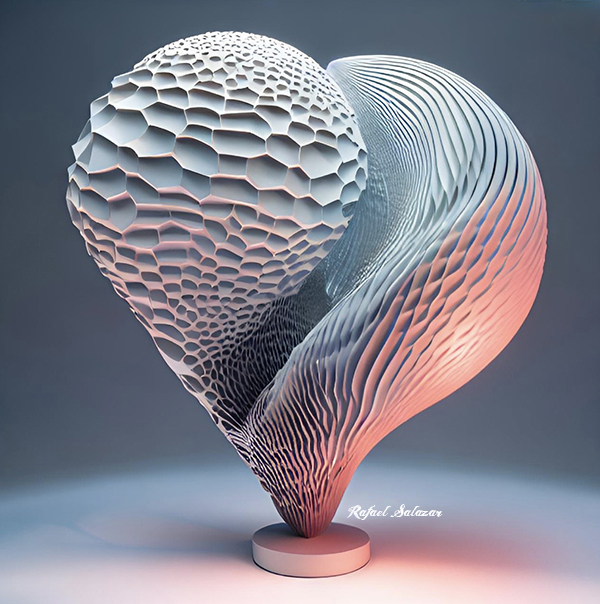
Cellular and linear structures curve toward one another, joining contrasting visual languages within a single organic form.
Copyright 2026 – All rights reserved by Rafael Salazar.
“Motionalism creates,” Salazar says with a smile. “Motiology explains.”
The distinction allows the visual work and the philosophy surrounding it to develop alongside one another. One communicates through image, form, energy and response; the other provides a framework through which the ideas behind those experiences can be examined.
What also distinguishes Salazar’s work is his perspective on technology and artificial intelligence. While many artists approach AI cautiously, he views it as another creative instrument within a much longer history of artistic evolution.
“Throughout history, artists have always adopted new tools,” he says. “The machine can assist, but emotion, discernment, responsibility, and consciousness remain human.”
For Salazar, embracing new technology does not require abandoning the human element. Instead, the question becomes what the artist chooses to do with the tools available and what human thought, judgement and emotion are brought to the process.
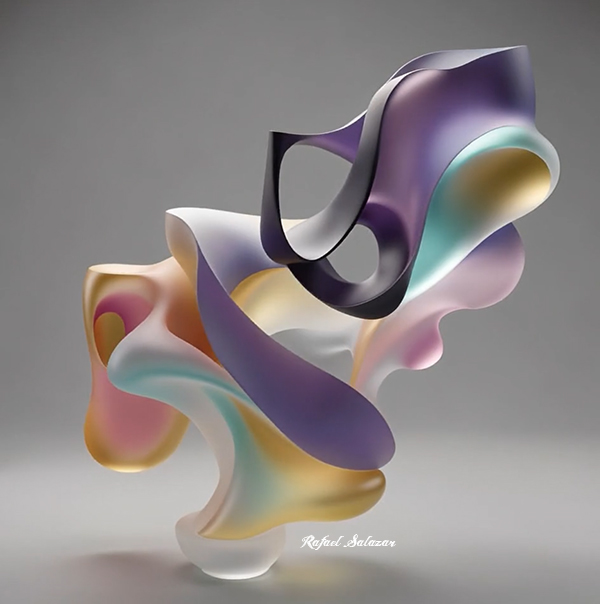
Soft biomorphic structures rise, twist, and intersect, dissolving the boundary between sculpture, color, and imagined movement.
Copyright 2026 – All rights reserved by Rafael Salazar.
That balance between the future and humanity defines much of his current work. His compositions can feel futuristic, yet deeply personal at the same time, reflecting a world increasingly shaped by technology while still searching for meaning, presence and emotional connection.
It also places his long career in an unusual perspective. Salazar has witnessed enormous changes in the ways art can be conceived, created, reproduced and shared. Rather than treating those changes as a threat to what came before, he continues to explore what they might make possible.
At an age when many artists focus primarily on legacy, Salazar remains firmly oriented towards the future. New collections, publications, philosophical texts and expanded presentations of Motionalism continue to emerge as the movement itself develops.
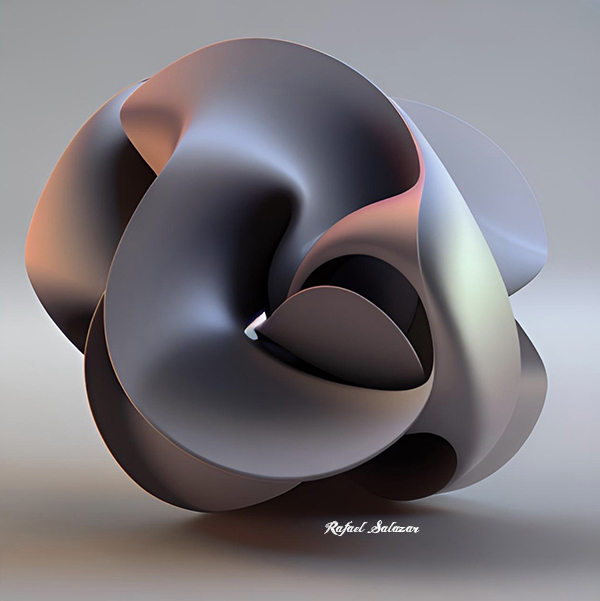
Interlocking sculptural curves fold into themselves, creating a continuous exchange between volume, shadow, tension, and space.
Copyright 2026 – All rights reserved by Rafael Salazar.
There is no suggestion that Motionalism has reached a finished form. In many ways, that would contradict its central premise. A philosophy concerned with movement and transformation must itself be capable of moving and transforming.
After more than sixty years of artistic exploration, Salazar therefore appears less interested in arriving at a final destination than in continuing the journey, questioning, creating and responding to a world that never remains still.
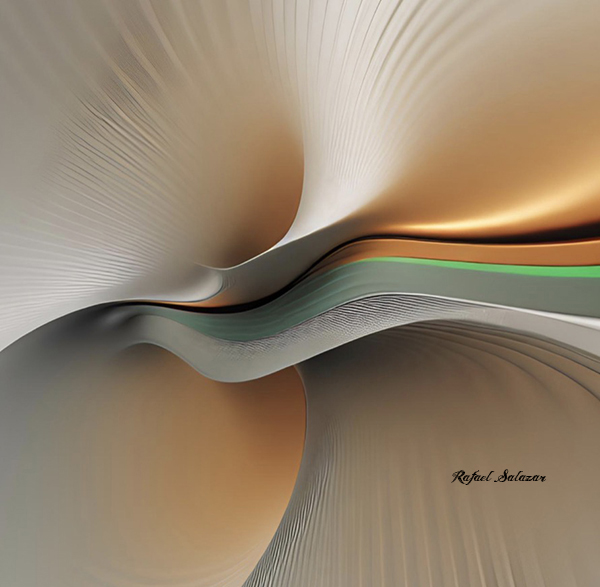
Sweeping layers curve, separate, and reconnect across a luminous field, transforming movement into a shifting perceptual experience.
Copyright 2026 – All rights reserved by Rafael Salazar.
Yet beneath the philosophy, experimentation and innovation lies a remarkably grounded message about the artist’s place within something much larger than any individual career.
“Art existed before us, exists through us, and will continue after us,” he says.
And perhaps that is the simplest expression of the idea behind everything else.
“Where there is movement — Motionalism continues.”
RafaelSalazar.com
Motionalism.com
About.Me
Linkedin
Pinterest
Tumblr
X
WordPress
You Tube
