
Getting To Know Rafael Salazar

Rafael Salazar

Founder of Motionalism | 82 Years Young

For more than six decades, Colombian born artist Rafael Salazar has explored the relationship between movement, emotion, memory and human transformation. It is an artistic journey that has continued to evolve throughout his life, responding to changing experiences, cultures and technologies without losing sight of the human emotions at its centre.

Today, at 82 years young, he continues that exploration through Motionalism, a contemporary artistic language centred on energy, silence, discernment and emotional motion.

“Motionalism™️ is not a style,” Salazar says. “It is a language.”
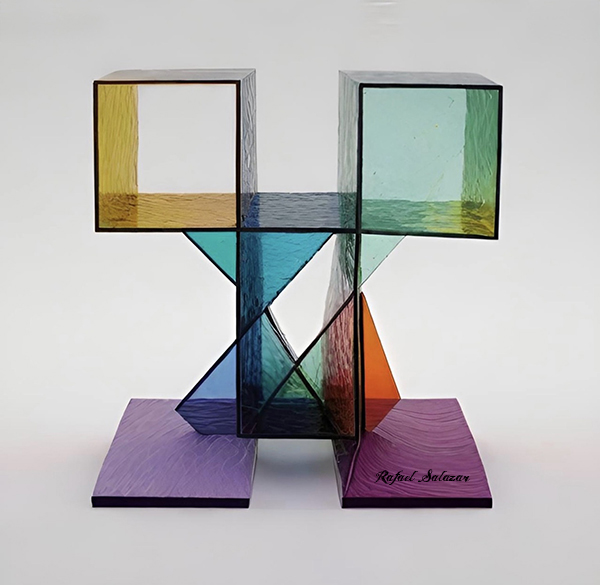
Geometric artwork by Rafael Salazar featuring transparent colored rectangular, triangular, and square forms in blue, green, yellow, orange, and violet.
Light becomes part of the structure.
Transparent geometric volumes intersect through color and light, creating a delicate balance between architecture, openness, and visual movement.
Copyright 2026 – All rights reserved by Rafael Salazar.

Born in Colombia and shaped by a lifetime of global experiences across the Americas, Europe and Asia, Salazar’s artistic journey has evolved far beyond traditional definitions of painting or sculpture. His work bridges instinct, abstraction, digital experimentation, philosophy and emerging technologies, while remaining deeply centred on human emotion and the ways in which people experience and interpret the world around them.

Rather than allowing a particular medium to define the work, Salazar places the idea and the emotional response first. The tools may change, but the underlying search remains remarkably consistent.

At the core of Motionalism is a simple but profound idea: movement is not only physical. It can also be emotional, psychological, spiritual and internal.

“Motionalism is the moment where motion becomes emotion,” he explains. “The invisible movement inside the human being becomes visible through art.”

This concept allows movement to exist without necessarily depicting something physically moving. It might instead be found in a change of feeling, an emerging memory, a tension between forms or that difficult to define instant when one emotional state begins to become another.
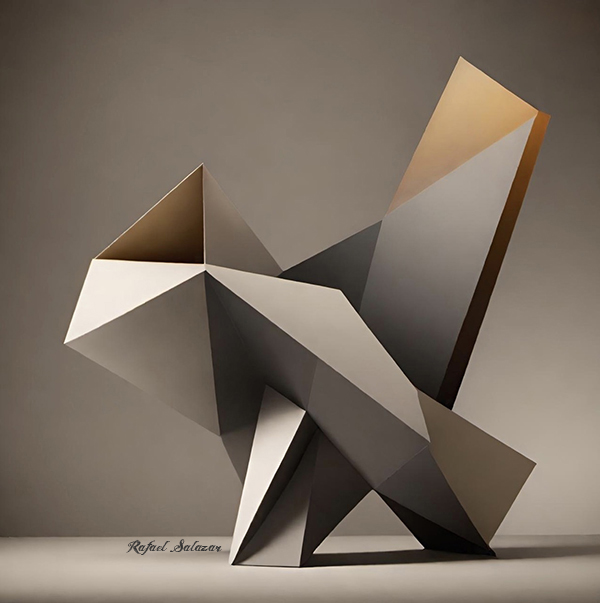
Geometric Motionalism artwork by Rafael Salazar composed of intersecting angular metallic planes in gray, black, cream, and warm gold.
Geometry moves through tension.
Angular planes intersect and counterbalance one another, turning apparent structural stability into an active experience of direction and force.
Copyright 2026 – All rights reserved by Rafael Salazar.

Rather than presenting literal subjects or prescribing a single interpretation, Salazar’s works often appear as luminous structures, energetic atmospheres, fragmented flows or suspended moments in transformation. Viewers may interpret the same piece in completely different ways, something he considers not merely acceptable, but essential to the movement itself.

“Only the observer possesses the message.”

For Salazar, the artwork is therefore never entirely complete until someone experiences it. The observer does not simply look at the work from the outside; they become part of its completion through personal memory, feeling and interpretation.

What one person recognises as serenity, another may experience as isolation. Movement may suggest freedom to one viewer and uncertainty to another. Neither interpretation needs to be wrong. The response belongs to the individual standing before the work.

This philosophy has become one of the defining principles of Motionalism and its theoretical counterpart, Motiology™️, the conceptual framework that explores the deeper human meaning behind the movement.
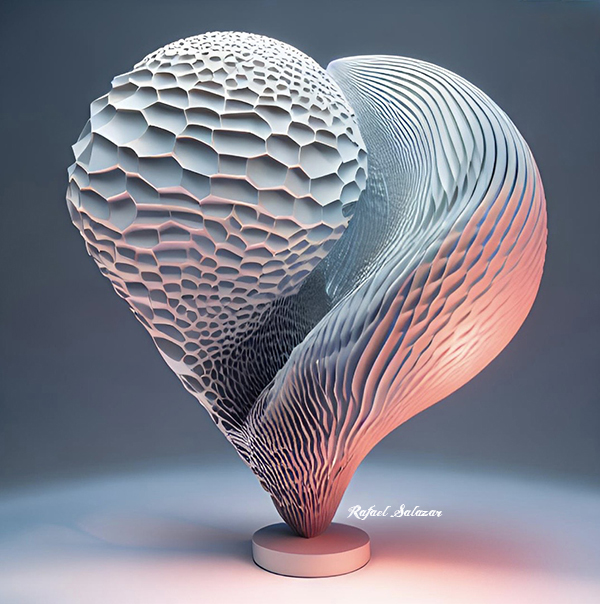
Heart-like abstract sculpture by Rafael Salazar combining cellular textures and flowing linear structures illuminated with soft blue and coral light.
Two systems move toward one feeling.
Cellular and linear structures curve toward one another, joining contrasting visual languages within a single organic form.
Copyright 2026 – All rights reserved by Rafael Salazar.

“Motionalism creates,” Salazar says with a smile. “Motiology explains.”

The distinction allows the visual work and the philosophy surrounding it to develop alongside one another. One communicates through image, form, energy and response; the other provides a framework through which the ideas behind those experiences can be examined.

What also distinguishes Salazar’s work is his perspective on technology and artificial intelligence. While many artists approach AI cautiously, he views it as another creative instrument within a much longer history of artistic evolution.

“Throughout history, artists have always adopted new tools,” he says. “The machine can assist, but emotion, discernment, responsibility, and consciousness remain human.”

For Salazar, embracing new technology does not require abandoning the human element. Instead, the question becomes what the artist chooses to do with the tools available and what human thought, judgement and emotion are brought to the process.
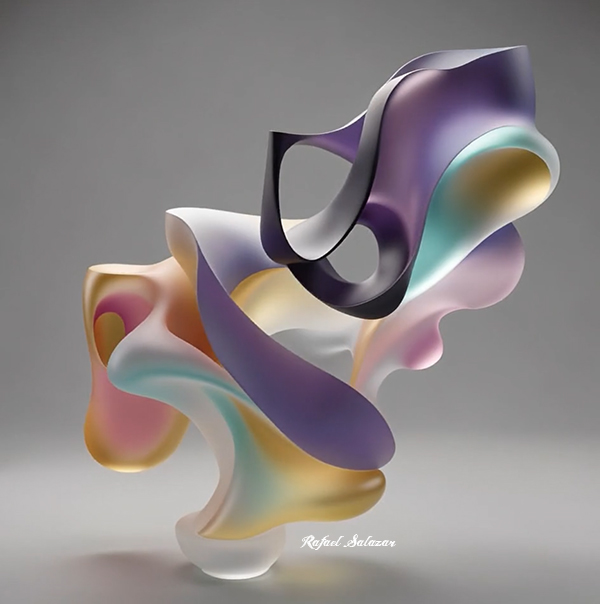
Abstract sculptural artwork by Rafael Salazar with flowing pastel purple, turquoise, pink, gold, and white organic forms.
Color discovers a body in motion.
Soft biomorphic structures rise, twist, and intersect, dissolving the boundary between sculpture, color, and imagined movement.
Copyright 2026 – All rights reserved by Rafael Salazar.

That balance between the future and humanity defines much of his current work. His compositions can feel futuristic, yet deeply personal at the same time, reflecting a world increasingly shaped by technology while still searching for meaning, presence and emotional connection.

It also places his long career in an unusual perspective. Salazar has witnessed enormous changes in the ways art can be conceived, created, reproduced and shared. Rather than treating those changes as a threat to what came before, he continues to explore what they might make possible.

At an age when many artists focus primarily on legacy, Salazar remains firmly oriented towards the future. New collections, publications, philosophical texts and expanded presentations of Motionalism continue to emerge as the movement itself develops.
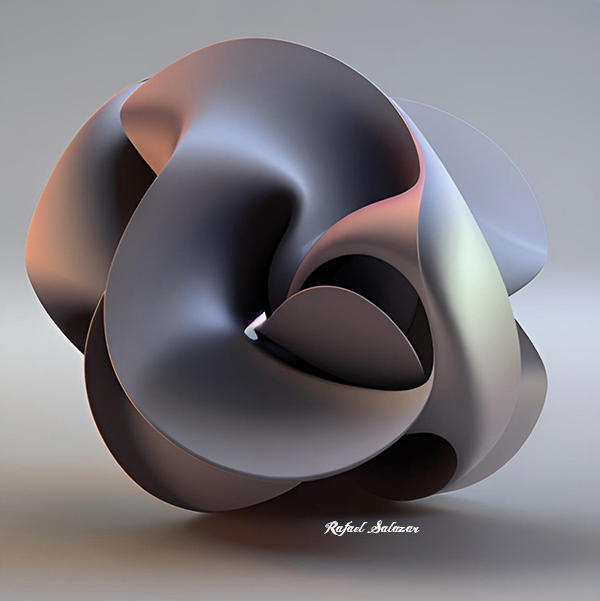
Sculptural abstract artwork by Rafael Salazar composed of dark metallic curved forms with subtle warm and iridescent highlights.
Form turns inward and discovers movement.
Interlocking sculptural curves fold into themselves, creating a continuous exchange between volume, shadow, tension, and space.
Copyright 2026 – All rights reserved by Rafael Salazar.

There is no suggestion that Motionalism has reached a finished form. In many ways, that would contradict its central premise. A philosophy concerned with movement and transformation must itself be capable of moving and transforming.

After more than sixty years of artistic exploration, Salazar therefore appears less interested in arriving at a final destination than in continuing the journey, questioning, creating and responding to a world that never remains still.
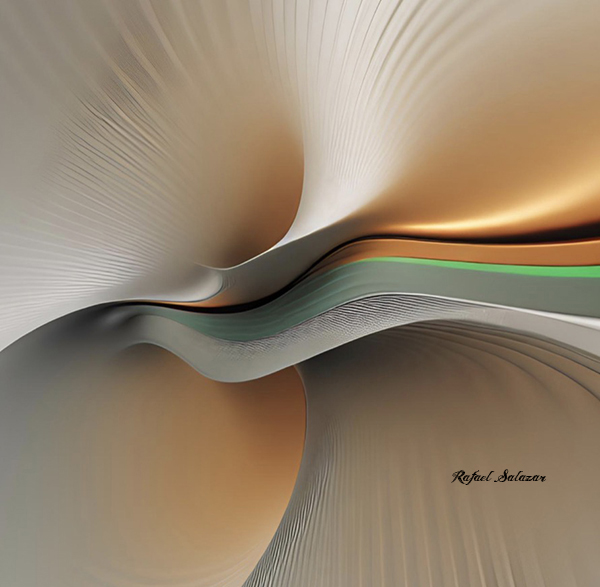
Abstract Motionalism artwork by Rafael Salazar featuring flowing cream, bronze, black, and green forms in continuous curved motion.
Motion bends until perception changes.
Sweeping layers curve, separate, and reconnect across a luminous field, transforming movement into a shifting perceptual experience. 
Copyright 2026 – All rights reserved by Rafael Salazar.

Yet beneath the philosophy, experimentation and innovation lies a remarkably grounded message about the artist’s place within something much larger than any individual career.

“Art existed before us, exists through us, and will continue after us,” he says.

And perhaps that is the simplest expression of the idea behind everything else.

“Where there is movement — Motionalism continues.”

RafaelSalazar.com
Motionalism.com
About.Me
Linkedin
Mastodon
Pinterest
Tumblr
X
WordPress
You Tube


Getting To Know weird sumbuk

John Moore aka weird sumbuk

There is something wonderfully fitting about a photographer whose childhood hero was Johnny Appleseed spending his early years wandering around the garden, poking holes in the earth with a stick and planting imaginary apple seeds.

While other children were drawing black hatted outlaws, capturing enemy soldiers or dreaming of ninth inning home runs, John Moore was apparently already looking at the world a little differently. His mother noticed too. Her Kentucky twang still echoes in his memory:

“Boy! You are one weird sumbuk!”

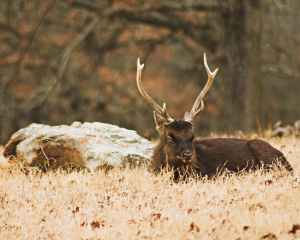
The name stuck, and today weird sumbuk is the name under which John shares a body of work spanning photography, digital experimentation and, more recently, AI assisted imagery.

Copyright John Moore aka weird sumbuk

Now based in Bartlesville, Oklahoma, after moving from Riverton, Wyoming in 2008, John describes himself as an Air Force brat. He was living independently by sixteen, with his parents’ consent on the condition that he found a job, and he went on to graduate from Fort Madison High School.

John cannot pinpoint exactly when art first caught his attention, but he remembers an incident from the age of twelve. A friend came to the house and asked whether he wanted to help him paint.

John declined because he was worried he might mess it up.

After the friend left, his father asked the obvious question: how exactly did John expect to mess up painting a fence?

To John, the word painting had meant making a picture.

He ran after his friend and helped with the fence anyway.

Before photography took hold, John thought he might become a poet. He spent time drifting and gathering experiences, hoping to create pictures with words, but repeatedly found himself wishing for a camera so that he could preserve the things he was seeing.

Those sights, he says, were well beyond the capabilities of his stick figure drawings.

Ask John which camera he uses and the answer is wonderfully uncomplicated: Nikon.

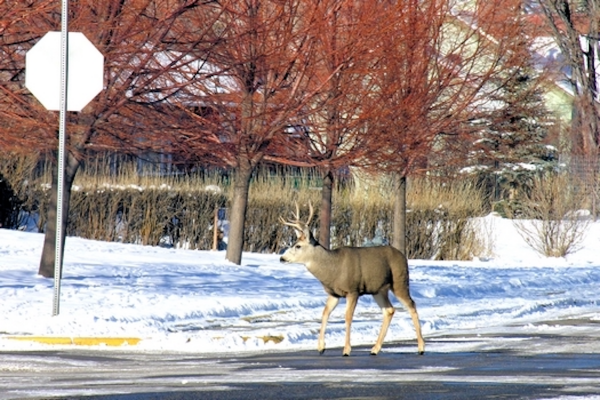
Copyright John Moore aka weird sumbuk

In 1983, a friend sold him a Nikon EM and two lenses because he intended to switch to Canon. After John’s first roll of ISO 100 film was developed, that same friend offered to swap his new Canon for the Nikon EM.

John refused.

“I heard a whisper and have had a Nikon since.”

That relationship with the camera has lasted for decades. For John, photography is less about constructing a technically perfect scene and more about recognising the instant worth keeping.

One photographer who particularly influenced him was Eugène Atget, and the philosophy John took from his work was simple: capture the moment.

John currently uses PhotoScape X, although he prefers to get as much right in camera as possible. Editing is generally kept to resizing and small adjustments.

His favourite image adjustment tool of all, however, belongs to another era: his colour head Omega enlarger.

His relationship with digital photography was not exactly love at first sight. Around 2000, as he puts it, he finally “quit whining digital wasn’t real photography”. He began scanning photographs and experimenting with software to turn them into something new.

Curiously, that experience has made the arrival of AI easier for him to accept. He now experiments with Copilot, sometimes beginning with one of his own photographs and allowing his imagination to take the image elsewhere.

“I want to show I do use AI to make images. This was easier for me to accept as a photographic tool than digital was back in the day.”

That makes his work particularly interesting. John has experienced photography through film, darkroom equipment, digital cameras, image editing and now generative AI. Rather than pretending those changes never happened, he has allowed his methods to change with them.

Of his own work, John’s favourite is Faithful Bison.

The photograph came from one of the family’s visits to Yellowstone. As Old Faithful erupted, a bison happened to be walking nearby. Despite having visited the area a couple of times a year, John had never before been there when an animal wandered close to the geyser during an eruption.

It was exactly the sort of fleeting conjunction his photography is built around: be there, have the camera ready, and recognise the moment when it appears.

Not every photographic moment survives.

John once photographed a neighbour’s pets and showed him several pictures on the back of the camera. The neighbour particularly liked a few of them, so John promised to download the photographs and email them over.

Copyright John Moore aka weird sumbuk

Then he went to remove the memory card.

There wasn’t one.

The photographs they had admired were temporary demonstration images and had not been saved anywhere.

Fortunately, both photographer and neighbour found it funny. John put the card back where it belonged and photographed the pets again.

When John and his wife were younger, long trips meant loading the children and his Nikon into the van and setting off, often without much of a plan. Camping and hiking in the mountains became part of family life, and the camera came too.

His family were not always delighted to find themselves in its sights. John remembers variations of “You’re embarrassing!” whenever the Nikon appeared.

These days, those same family members ring him asking for photographs from the day.

His wife once told him his photography was getting out of hand. Now they sit together looking at those photographs on a large television, seeing their children and the places they visited years ago.

She squeezes his hand and smiles.

Perhaps that explains better than anything why John photographs.

His son has called him a “selfish photographer”, because John admits that for many years the photographs were primarily for himself and his wife to enjoy when they became old.

As John now says simply:

“Old age is now.”

John has never been particularly interested in becoming known. He does not actively market his work and has little enthusiasm for social media. Fine Art America gives him somewhere to share what he has seen, while also allowing him to discover the work of other artists.


Nor is he pursuing commissions. Friends and family occasionally ask him to photograph their children or pets, and he is happy to do it for the pleasure of using his Nikon.

There is one condition when photographing children: he lets them play and be themselves.

It fits his wider philosophy perfectly. Don’t force the moment. Watch for it.

John has never followed a formal photography course. Instead, he read books on photographic history, studied photographs in magazines, watched television with an eye on how scenes were framed and cropped, and, in his words, wasted plenty of film learning what not to do.

He is equally comfortable receiving constructive criticism. Improvement, he believes, is always possible. Criticism based solely on somebody disliking a particular image is different. Not everybody enjoys the same things, so he listens and moves on.

His advice to new photographers comes from the same uncomplicated philosophy:

“Learn the rules, but shoot what catches your eye, and catch that moment you know the emotion is going to show.”

John has never tried drone photography.

In fact, he says he has never really thought about it.

Then comes the inevitable question:

“Does Nikon make a drone?”

There is another reason John’s son encouraged him to let other people see his photographs.

During a serious medical situation, John found himself in hospital where a doctor asked him, “How are you still alive?”

The experience left him considering whether perhaps the photographs he had accumulated should be shared rather than simply kept.

They were never created with fame, exhibitions or sales in mind. They were made because John happened to be somewhere, saw something worth remembering and had his Nikon with him.

Perhaps that is precisely why they matter.

His photographs contain the roads travelled, the animals encountered, children growing up, landscapes visited and those peculiar fractions of a second when everything happened to fall into place.

And somewhere beneath all of it is still the boy wandering around a backyard with a stick, planting imaginary apple seeds where nobody else could see them.

A Few More Things To Know

John’s musical tastes lean towards rock and roll with a smattering of blues, and Janis Joplin remains his all time favourite singer. YouTube itself holds little attraction for him unless his seven year old grandson is involved, in which case video game videos apparently take command.

His hobbies these days include photography and, as he puts it, letting his grandchildren spoil him.

He has no gallery exhibitions planned and does not seem especially troubled by that. The work was never really about gallery walls.

It was about seeing.

And remembering.

See more work by weird sumbuk:
Portfolio on Fine Art America

Our Arts Mag'
Privacy Overview

This website uses cookies so that we can provide you with the best user experience possible. Cookie information is stored in your browser and performs functions such as recognising you when you return to our website and helping our team to understand which sections of the website you find most interesting and useful.