Are you feeling a bit stuck in your blogging journey? Are you less passionate about your blog than when you first started out? Blogging can be a difficult endeavor and sometimes, it might feel like the spark has gone out from the fire. But don’t despair: there’s still hope! In this blog post, we’ll explore six ways to get back into the game and reignite your passion for blogging: revisiting your purpose, finding inspiration again, understanding your audience, connecting with other bloggers, reflecting and evaluating, crafting compelling content and setting goals. So read on and let’s start moving forward!
Revisiting Your Purpose
Revisiting your purpose for blogging is an important step in reigniting your passion. Do you blog to raise awareness on a particular topic, share experiences with others, or simply express yourself? Take some time to reflect and recall the reasons why you started blogging in the first place. Remind yourself of the reward and joy that comes from creating and sharing content with people around the world. This can be just the boost you need to start feeling excited about blogging again!
Finding Inspiration Again
If you’ve been feeling blocked lately when it comes to blogging, don’t worry – it’s normal. It happens to everyone, and the best way to counter this is by finding your inspiration again. Take some time to explore different topics that interest you; new books or movies, celebrity interviews, trending topics – anything that could potentially spark an idea or awaken a passion. Trying something outside of your comfort zone may just be the kick start you need to reignite your blogging fire!
Understanding Your Audience
No matter how creative and exciting your blog posts may be, they will not benefit from full success unless you fully understand your audience. Who is likely to be reading your blog? What are their interests and needs? Once you can answer such questions effectively, it should become much easier to determine what type of content you should post on your blog and how best to present it in order to engage your audience. Understanding who you are writing for allows you to tailor the style, tone and structure of each post, making sure that whatever stories or messages you want to share have the highest chance of being well-received. Your readership is also likely to grow if you keep them engaged; so understanding what attracts visitors in the first place and understanding how to maintain their interest is an integral part of reigniting your passion for blogging.
Connecting With Other Bloggers
As you look to reignite your passion for blogging, connecting with other bloggers can be a great way to find motivation. Joining online communities such as Twitter chats or forums can be a great place to find other like-minded writers. You can create meaningful relationships by being open and honest about the current state of your blog, as well as how you hope it will evolve in the future. Developing an online support network of fellow bloggers is invaluable to boosting creativity and motivation. Additionally, many blogs have guest post sections that allow you to connect with new people while also providing additional content for readers. Lastly, participating in blogging challenges that focus on a certain topic or style of writing can help spark new ideas and keep things fresh when inspiration hits a wall.
Reflecting And Evaluating
As you come to the end of this guide, take a moment to reflect and evaluate your blogging journey so far. Ask yourself what worked and what didn’t work in reigniting your passion for blogging. Think about which methods helped you gain clarity on the type of content you want to be creating and how you can still make it enjoyable. Consider if there are any additional activities that could further help boost your creativity or writing skills. Reflecting and evaluating will not only help you continue on your journey of reinvigorating your blog, but it may also give you insight into areas of self-improvement, giving you more purpose in life as well.
Crafting Compelling Content
Writing compelling content is the cornerstone to any successful blog. It can be a challenge to come up with fresh and interesting content, but it’s important to find new ways to keep your readers engaged. Crafting content that sparks conversation is key to keeping your readers interested – from asking thought-provoking questions and sparking debates, to writing stories that draw in your readers, you need to create posts that will make people want to come back for more. Having an editorial calendar and brainstorming ideas on how you can engage your readers will help you reignite your passion for blogging and get back in the game!
Setting Goals
It’s important to set goals when reigniting your passion for blogging. Start by writing down a list of objectives that you want to accomplish with your blog. What kind of topics do you want to cover? How often do you plan to post? And what type of readers do you want to reach? Once you’ve set your goals, create a realistic timeline and plan for achieving them. Don’t be afraid to break up larger goals into smaller, more achievable chunks. Finally, make sure that the goals are motivating and inspiring so that they continue to keep the fire burning in your passion for blogging!
Conclusion
In conclusion, blogging can be a great creative outlet if you reignite your passion by taking the steps outlined in this guide. Start with assessing what isn’t working and why, then focus on making it fun and interesting again by switching up your content, refreshing your design, and optimizing for search engine visibility. Finally, involve yourself in the blogging community to keep yourself motivated and inspired. With these tips and some hard work, you’ll be back in the game of blogging success before you know it!
This is a republish of an old interview I had with Piers a few years ago. A friend wrote to him when I was running 1stAngel.co.uk asking if he would allow me to add an interview with him. I think we were both surprised when he said yes! A lot has happened since then to the sites but I have always kept livingly safe this interview, and now I share it again for everyone to read on the new updated site
Interview With Author Piers Anthony
In school I hated history classes. This was ironic, because the study of human history has been a hallmark of my later life. So what was the problem in school? It was that a school’s idea of history was lists of the names and dates of kings, the dates of battles, and maybe some lists of products of the times. Things to memorize. I was never good at memorization. Climate of Change*
When did you first become interested in writing?
Two years into college, I had to choose my major. I had been interested in higher math, but that had been blotted out in high school when I was required to take four years of languages instead. I was fascinated by psychology, but lacked the credits to take that farther. I loved art, but six years of art classes in high school and college finally satisfied me that I lacked the talent to earn my living as a commercial artist. So I pondered, and in a day and a night realized that I wanted to be a writer. It was like a light turning on, and it has guided me ever since.
What style of writing do you use most?
I use whatever style seems to work best for the subject or story I am writing. In the course of more than 140 books I have used different styles.
Mainly I want to be clear, interesting, and relevant.
Has your style changed from when you first began as an author?
I hope my finesse and precision of expression have improved with experience.
So the kind of history I liked was ancient, before there were names and dates. The problem was that there were no classes in that. So I had to research it myself. But there were huge gaps. Here is a typical example: modern man emerged from Africa about 100,000 years ago. Then he expanded throughout the rest of the world about 50,000 years ago. What happened in between? It was a mystery. It aggravated me. Climate of Change*
In what way do you usually put down your ideas first?
Originally I typed on a manual typewriter. Then when my hyperactive daughter was born, and I took care of her while my wife worked to earn our living, I changed to pencil on paper. That was so I could literally drop it in an instant to try to catch her before she fell. So my early bestselling novels were pencilled first. Seventeen years later, when she went off to college, I realized that this was no longer necessary, and switched to the computer. But I still scribble idea notes on paper, because ideas can occur at any time, such as when I’m eating, working, showering, or in town with my wife, and if I don’t catch them when they come, I may never remember them thereafter. Later I transcribe those notes to my burgeoning Idea File, so that they are there for me when I need them.
What made you choose that medium?
The computer? Two reasons: they stopped making good manual typewriters, and the computer saved me from having to retype from scratch. I could revise freely. The computer is almost as good in that respect as pencil, and considerably faster.
Do your ideas come from life or imagination?
My ideas come from anywhere. Let me illustrate by relaying a joke about the composer Beethoven: he had written four symphonies, but was stumped for a theme for the next. As he struggled against the determined blankness of his mind, his cleaning woman came by the office. She paused with her mop, and said “If you don’t mind my asking, sir, how do you ever come up with those great tunes you do?” How indeed! But he replied politely “Oh, I can get an idea from anywhere. Even from you, my dear.” She was amazed. “Me? Me Ha ha ha haa!” in the first four notes of Beethoven’s Fifth Symphony. It s like that with me too.
How do you choose your characters, if fact, how do you choose the subject?
I start with the story, then fill in characters as needed. Once I select a character, that person starts to define him or her self, becoming individual. Rarely I will adapt from life. This was the case with Jenny Elf in my Xanth fantasy series. Jenny was a twelve year old girl who had been struck by a drunk driver and put into a three month coma. I wrote her a letter at the behest of her desperate mother and offered to put her in a novel, as she loved the Xanth series. This roused her from the coma, but then it turned out that she was almost completely paralyzed. Jenny Elf does all the things Jenny Mundane can’t do. I still write to her weekly, trying to make her situation less difficult.
My nonfiction has mostly been biographical. There is however a very strong research basis for my GEODYSSEY historical series. I chose that because I am fascinated with mankind’s nature and history and don’t much like the way it is taught in school, which forever turns off students so that they prefer ignorance to knowledge of our species.
Now at last we have a hint: it was the climate. Mankind was spreading, but then came the Mt. Toba volcanic eruption, 74,000 years ago, of a scale we have never seen in historic times. It blotted out the sunlight and obliterated perhaps 99% of human life, and I think all of it outside of the home territory of Africa. Mankind had to recover and start over after that setback, from a far smaller base. This time there was no eruption of that magnitude, and he succeeded in colonizing the world, though constantly affected by the weather. Climate of Change*
Who is your favourite author?
That keeps changing, and I have to say I have no fixed favorite. Back in my day, the top three genre authors were Heinlein, Asimov, and Clarke; I liked them all, plus Jack Vance, Theodore Sturgeon, and others.
What is your favourite piece of work by yourself?
My historical novel Tatham Mound, and the GEODYSSEY series. In fantasy, it is my ChroMagic series. Neither of these is well known, however; I am generally known from my Xanth series, which is light and punny fantasy that takes nothing very seriously. Xanth is a land that looks like the state of Florida, in America, with magic added. For example I live near the Withlacoochee River, which in Xanth becomes the With-A-Cookee River, with cookies growing by its banks. I live on a small tree farm by Lake Tsala Apopka, which in Xanth is Lake Tsoda Popka, with many flavors of soda pop. It is hardly deep literature, but it is popular.
How much time (on average) does it take to complete a work?
A serious novel may take six months. Each GEODYSSEY novel did, though I had a paid researcher; otherwise they would have taken a year or more. A simple Xanth novel takes under three months. My fastest was in six and a half weeks. Despite the opinion of critics, nothing I write is carelessly dashed off; I do my best to make it the best of its type that it can be. I turn out novels rapidly because I spend full time on it. Writing is my livelihood and my life.
How well do you take criticism?
About as well as the average writer does. More specifically, a critic is finely crafted from fecal matter. Thus he is a turd that walks and talks like a sh*t. It’s a good thing you asked when I was in a good mood.
I also have a broader idea of history than conventional texts do. I see it as a process dating from when mankind separated from the apes, several million years ago. When he left the trees, walked on two feet, learned to use tools, started wearing clothing, and learned to talk. I believe that the phenomenal tool of language powered his explosive increase in brain size. That brain made it possible for him to conquer the world, once he learned how to use it. Climate of Change*
What do you do to overcome a ‘block’?
In college I took drama and was in several plays. I discovered that I could not afford stage fright. As a math teacher in the US Army, and later as a civilian English teacher, I came to the same conclusion. So I worked to eliminate it, and have not suffered from it since. Writer’s Block is similar, and similarly unaffordable for a writer, and I got rid of it similarly. I really don’t suffer total blocks, the kind that prevent a writer from writing anything for years at a time. I think such writers aren’t really serious about writing. I developed what I call my [bracket] system: when I come to a place in the story that seems to be a dead end, I go into [brackets] and discuss the problem with myself. Why brackets? Because the point is to keep writing, whether in pencil or typing, but not to confuse it with the story itself. When I had only the one pencil and paper, or the one manual typewriter, the brackets allowed me to do this on the same page without confusion. Such a discussion might be one sentence, or it might be three thousand words. Whatever it took. Then when I figured it out, I exited the brackets and resumed writing the story. Next draft, I would edit out the bracket notes, as they had accomplished their purpose, leaving only the text. Today I have a separate computer file for it, but the principle is the same. A facetious example of such a note: [My protagonist has just taken the woman of his dreams into his embrace. She is absolutely lovely and is gazing into his face with sheer adoration. What does he say or do now? Ask her the time of day? Burp in her face? This would not go over well. Aha! I think I’ve got it. He can say “I love you” and kiss her. What a struggle to get that original notion!] I use this system constantly. That’s why I never really block. It should work for another writer too, if he is serious about writing.
How do you know something is ‘finished’? Is it easy to walk away?
My novels have definite plots that come to solid conclusions. Of course I do tinker, revise, and edit, which I regard as putting the final polish on a gem. I have trained myself to recognize when such tinkering is yielding diminishing returns, and to let the piece go. I do suffer separation pangs, as it is a world I am departing from. So I start the next novel, and that distracts me.
Have you had been published?
Oh, yes. Too many novels, stories, and articles to track, let alone list.
I have been writing full time since 1966 and am one of the most prolifi
c writers in the Science Fiction / Fantasy genre. 21 of my fantasy novels made the NEW YORK TIMES national bestseller list in the 1980s. I’m not a bestseller now, but anyone can find my works by Googling my name.
Have you any publications planned for the future?
I am constantly writing. The problem is getting my books published, especially the more challenging or original ones. At the moment I have a horror novel The Sopaths that may be unpublishable because it pushes some wrong buttons. There will be Xanth novels in the future; more serious works are problematical.
There were other mysteries. Why did he lose his fur, so that he had to replace it with clothing? Why did human women, alone of all mammals, develop permanent breasts that weren’t needed for feeding her babies? Climate of Change*
What are your plans for the future?
To keep right on writing. When I die I’ll be half through a great novel.
What advice would you give new authors?
Write for love rather than for money, because no one has any certainly of getting successfully published. There are something like a hundred decent novels for every one publishing slot. Fortunately affordable self publishing now exists. I was active in that, investing serious money in Xlibris because I wanted that option to exist. Now it does, though Xlibris may not be the company it was in my day. I also maintain a candid ongoing survey of electronic publishers and related services at my www.hipiers.com web site, so that new writers can shop for publishers without being deceived about the bad ones. I do it in significant part because I have the will and the means to take it to any bad publisher that tries to threaten me (and some do); otherwise the truth would not be known, and writers would get deceived or cheated more than they do now. So when you have your novel, try the traditional print publishers, then the electronic publishers, then as a last resort, the self publishers. I wish every writer could be one of the hundred, but that’s unrealistic.
Have you done any courses to help you?
Way back when, I took the correspondence writing course by the Uzzles. I concluded that they did not properly know what they were doing, and thereafter proved it by forging my own way.
What do you do to market your work?
I let the print publishers do the promotion. Apart from that there’s just my web site, which may be considered a promotional tool, though I regard it mostly as a service to the writing profession.
Have you got hobbies?
I practice archery for exercise, and ride a recumbent bicycle. Otherwise, writing is my hobby as well as my profession.
Where are you based?
Florida, America.
* The included snippets are from the introduction to my last published novel, Climate of Change, copyright 2010, published in hardcover May 2010 by TOR. It is the concluding novel in my historical GEODYSSEY series.
Another interview I had to bring from the now closed site, 1stangel.co.uk which was hacked 🙁
I met Chris when he gave a reading in our local library. His books are about my local area and are really easy to read and fabulous!
Chris Sims – Author
Interview with Chris Simms – British Author
He knew about his great-grandfather, Padraig. The giant navvy who, back in the late eighteen hundreds, had gathered enough money through bare-knuckle fighting to get his family out of the Manchester slum known as Little Ireland. – Sleeping Dogs
Chris Simms has worked in airports, nightclubs, post offices and telesales centres. After travelling throughout the world, he settled near Manchester where he lives with his wife and four children.
Along with nominations for the Theakston’s Crime Novel of the Year award and Crime Writer’s Association Dagger awards (for his novels and short stories), Chris was selected by Waterstone’s as one of their ‘25 Authors For The Future’.
When did you first become interested in writing?
I’ve always enjoyed writing but, until my late twenties, had only managed short stories – solely intended for the enjoyment of friends and family. However, at the back of my mind a nagging voice periodically cut through. It pointed out that I still hadn’t written the novel I’d always meant to.
EXTRA. I fear I’m giving myself repetitive strain injury because I spend too much time typing.
What style of writing do you use most?
My background is as an advertising copywriter. And since no-one buys a newspaper or magazine to read the adverts, you’re taught to use words economically and to make every line count. So I guess my favoured style is ‘terse’!
Has your style changed from when you first began as an author?
Not really. I re-read my lines more, always looking to rearrange or shorten to get what I really want to say jumping out. I’ve tried to learn how to punctuate properly. In that sense, perhaps I’m slightly more polished.
The huge dog immediately released its grip and, with spade-like head hung low, swung its gaze in Jon’s direction. The movement reminded him of a big cat: a lion or leopard getting ready to defend its prey. – Sleeping Dogs
In what way do you usually put down your ideas first?
Longhand, pencil, A4 lined pad. I only use the left-hand side. This leaves the right-hand side free for later amends / additions / notes to myself.
What made you choose that medium?
Writing straight-to-screen doesn’t work for me. It creates a strong urge to get it right first time. I like the freedom of adding new bits in, scribbling little arrows to move things around, grabbing a rubber and physically removing stuff…
Do your ideas come from life or imagination?
Both. I have read newspaper articles that have sparked an idea. But I have also been day-dreaming out of a train window and seen something that did the same thing. Often the idea is incredibly vague – but I always know if it will, eventually, turn into a viable plot.
How do you choose your characters?
Characters don’t come that easily to me. I think that’s because a lot of my stories are driven by plot, not people. I’ll try and draw a character, complete with descriptive labels like ‘long, straight nose, nostrils that flare when impatient’ to bring them to life in my mind.
Jon’s eyes locked on the van’s rear. The rag covering the registration plate had been removed and he glimpsed a series of numbers with a single letter in the middle. The vehicle was from Ireland. As he sprawled into the grass, he closed his eyes. Was the attack on Punch revenge? he wondered. Revenge for what I did in Clifden? – Sleeping Dogs
Who is your favourite author?
I’m tempted to say Cormac McCarthy, but people will probably think I’m jumping on a bandwagon. (I’m not. I read All the Pretty Horses years ago when it was a freebie included with a magazine my wife bought.) So I’ll say Graham Greene instead.
What is your favourite piece of work by yourself?
Aah – you can’t ask that! Would you ask someone to name their favourite child??? (I have included snippets from Sleeping Dogs)
Sunlight suddenly broke through, bathing the landscape in an ethereal glow. The finger of water bordering the right-hand side of the road turned to a shimmering stretch of lava and he had to squint against its glare. Then the hills were behind him and the terrain abruptly grew flat. – Sleeping Dogs
How much time (on average) does it take to complete a work?
I think about nine months. My editors would probably say ‘add another six for turning it into a proper book.’
How well do you take criticism?
When editorial comments come in, I’ve learned to walk away from the computer. No reply I come up with in the first twenty-four hours is safe to send. I’ve also learned that 90% of suggestions are, actually, perfectly sensible.
EXTRA: Accept the fact, if you write novels, your friends will suspect you of trying to mine their lives for juicy ideas.
What do you do to overcome a ‘block’?
Touching wood here, I’ve never experienced it.
How do you know something is ‘finished’? Is it easy to walk away?
As he looked at the mass of dark buildings ah
ead, his foot lifted from the accelerator and his speed began to drop. I’m here because of a phone call from someone I don’t know. And all I have is her word that it’ll be simple to get Zoe out of this place. – Sleeping Dogs
That’s tricky. Did someone say a poem is only finished when the poet runs out of time? It’s tempting to endlessly tinker with a novel, but easy to get yourself lost doing it. A deadline, in that sense, is great.
Have you any publications planned for the future?
A novel-length ghost story to come out before Christmas. Readers often say that, for crime novels, my books can be very scary. So I thought I’d go into that area a bit more heavily.
What are your plans for the future?
To find a way of balancing writing with earning money! Economically speaking, creating novels is a ridiculous use of your time.
What advice would you give new authors?
Treat it is a pass time that, if you’re lucky, generates a bit of cash. And don’t ever give up the day job…
Have you done any courses to help you?
No: I just waded in like an idiot.
EXTRA: Completing a book is only the end of one stage; getting it published is a different thing entirely. Remember, publishing is an industry the ultimate aim of which is to generate profits for the publisher.
What do you do to market your work?
Not enough beyond the usual web site / Facebook activity. I also edit Case Files, the online magazine for The Crime Reader’s Association. That gets my name out there a bit.
Do you use social networking in your day to day life?
To be honest, social networking fills me with unease. I think it’s taking a negative toll on too many peoples’ lives. Having said that, I’ve grown quite fond of my Facebook page – probably because I only do one update per week.
(www.facebook.com/AuthorChrisSimms)
Are you interested in collaborating with artists?
Funnily enough, I’ve just done exactly that with a photographer based in Wales. The story is out in spring, details will be on my Facebook page nearer the time…
Have you got hobbies?
I have four kids: their hobbies are my hobbies. I’m good at drawing ogres, dragons and princesses. And my train track creations are incredible.
Where are you based?
Twenty minutes outside Manchester, UK.
Sleeping Dogs, launched on a Kindle Countdown deal on the 28th October 2014
I became interested in art as a viewer, not an artist in my youth. We lived in a small city with no art galleries. I studied art through books about painters.
What about photography in general?
I have shot photos since school, but that was not fine photography.
Golden Butterfly Abstract @Yury Tomashevich
Which camera do you use most?
Sony A6000.
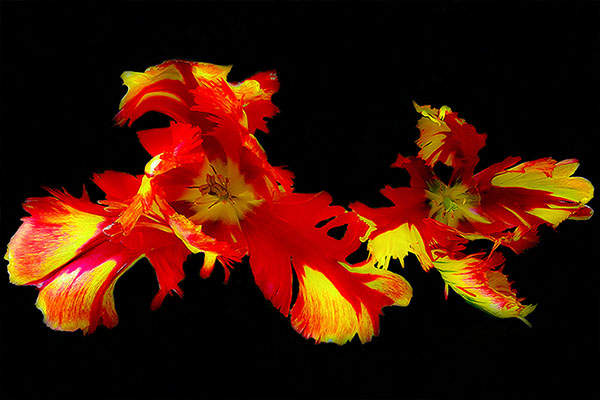
Tulip Feast @Yury Tomashevich
What made you choose that camera?
It is a good camera with relatively small size and weight.
SIDENOTE – I did a Kirlian photography and saw life after death with my own eyes.
Here is the story.
My most exciting photo images were made in 1969. No photo camera was used.
Semyon Kirlian in USSR discovered that if an object on a photographic plate is connected to a high-voltage source, an image is produced on the photographic plate. That discovery happened in 1939. That kind of photography was later named Kirlian photography. However, for a long time, the broad public did not know it. Only in the 70s years of the 20th century did the first international conferences on Kirlian photography start to appear.
In 1969 our team of several friends at an Optical Institute in Sosnovy Bor in Russia built high-voltage equipment. That equipment provided a short electrical impulse with an initial voltage level of up to 35 thousand volts.
In the fall of 1969, we were hit by an article about Kirlian photography in the popular magazine “Technika molodezhi” (Technology for Youth). The most interesting for us was a statement that with Kirlian photography, it is possible to see (on a Kirlian photo) an image of a non-existent (cut-off) part of a living leaf. We were immediately intrigued.
It was late September. Snow was everywhere. Still, we were lucky to find out several last living, not withered leaves on an oak tree nearby. We took a leaf from the tree and put it onto a sheet of photo-printing paper. That was done in a dark room. We put that sandwich of printing paper and a leaf into a black paper envelope and sealed it.
That envelope was posted on a table in our high-voltage equipment. Then we applied a high voltage impulse to it. After that, we removed the oak leaf and processed the photo paper for printing in the darkroom using the standard photo paper processing technique. This procedure gave us a Kirlian photo of a whole living leaf.
Then we cut off a part of the oak leaf with scissors, about 15 percent of the entire leaf area. The cut-off portion of the sheet was thrown into a trash can in the next room. At that time, the remaining piece of the leaf was still green and alive. We then took Kirlian photographs of this leaf several times over the next six hours. We were careful to keep our experiment clean. A new black paper envelope and a new sheet of printing paper were used for every separate photo.
We were amazed at the results. I had one such Kirlian black-white photo with a partly cut leaf at my home. Unfortunately, it was lost somewhere in 1997 while we were preparing for immigration to the USA. Therefore, I could not post here an output of our experiment with Kirlian photography.
A top part of the leaf on this Kirlian photo was cut off and thrown away.
In our experiment, we still saw a cut-off part of the living leaf for about 3 hours since we took that leaf from the tree.
We observed the part of space where this part of the leaf was before we cut it off and threw it away. In the Kirlian photograph, we see a bright glow in uncut, living part of the leaf. This glow is a representation of life in this leaf. We also see a less vivid continuation of this leaf’s life in that empty space where the now cut-off part of the leaf used to be. Over time, the leaf’s life in the place where the leaf no longer exists weakens and then disappears altogether.
I saw it. Two of my friends on our team saw it. We did show our Kirlian images at the time to many other people. They saw them.
That small black-white photo, on which a cut-off part of a living oak leaf was clearly seen, was the most exciting photo I have ever taken. And the biggest regret in my life as a photographer is that I lost this photo.
Do you use a photo editor?
I use Photoshop with a small amount of editing.
Do you enjoy the photography or the editing more?
Creating abstract artwork from a photo is very different from making an abstract painting by a painter. The painter has much more freedom than a photographer. The painter starts from the blank canvas. Photographer has to have a vision of what could be done from whatever he could shoot to make it into an abstract artwork. And then he should actually do that transformation. Both stages are intertwined and enjoyable.
City Abstract BW @Yury Tomashevich
Which other photographer, dead or alive, would you love to meet?
I prefer to meet a painter, not a photographer – Pieter Bruegel the Elder.
What is your favourite piece of work by yourself?
My favorite piece of work is “Blessing of Thousand Suns.”
Blessing of Thousand Suns @Yury Tomashevich
How well do you take criticism?
I take criticism well. I could be angry inside if comments are nasty, but I try to calm down and see if there is anything positive for me in this critique. Feedback is an important and needed component to becoming a better artist.
In this book, I showed the direction of the history of humankind during the last 44 thousand years. That direction is not related to subjective terms like progress, morality, happiness, or alike.
How fast is humankind moving in the found direction? Is that move controllable by humans? Why do humans rule the Earth? Which force is driving humanity’s development? Those questions also are answered in my book. I looked at history from the viewpoint of a precise science. The book concludes with a discussion of which circumstances could shortly lead us off the uncovered course.
Do you travel far when photographing?
I do not travel for photography though I do photos while traveling.
Leonard Cohen – Dance me to the end of love
What was the best advice given to you as an photographer? What advice would you give new photographers?
I did not get any generic advice from anybody as an artist or photographer. I find the inspiration in Winston Churchill’s words: “Never give in, never give in, never, never, never, never-in nothing, great or small, large or petty — never give in except to convictions of honour and good sense.” That advice is for everybody.
Do you think the internet has altered the way photographers can get known?
Of course, the Internet and, specifically, social networks altered how artists/photographers can get known. I started as an artist in 2016 when social networks were already pretty mature. Thus, I could not compare and conclude was it easier before or not.
Rain in a Desert Abstract @Yury Tomashevich
Have you done any courses to help you?
In my twenties, I attended one small course in watercolor painting. It was very good for me, and I still remember the details.
The most exciting art exhibition I ever saw was the Modigliani exhibition in LA in 2003. it was the first major Modigliani exhibition in the United States in more than 40 years. He often painted people’s eyes with a flat color. Yet, if you look at his paintings face-to-face, you see that those eyes are very expressive. This magic is totally lost in reproductions of his paintings in books.
What do you do to market your work?
I market my artwork mostly in Facebook groups.
Leaves @Yury Tomashevich
Are you available for work (commissions)?
I didn’t do it, but it would be interesting to try.
Peaceful @Yury Tomashevich
Have you got hobbies?
My creative work is my hobby.
Do you have a significant other? Are they supportive?
My wife, daughter, and grandkids are all supportive. Per my daughter’s request, I bought one of my artworks for her.
Very creative look at “The Hunters in the Snow – Painting by Pieter Bruegel the Elder” See it from 2:09:24 to 2:11:19
What do you dream about when asleep?
I do not remember my asleep dreams.
Where are you based?
I live in Silicon Valley, California, in the small town of San Carlos, between San Francisco and San Jose.
In my 20’s living in NYC with several roommates I/we developed an interest in photography. I bought a Canon SLR and a large zoom lens and we shot black & white. We converted our apartment kitchen to a darkroom!
What style of art do you use most?
I mainly create fine art nature photography. And abstract photo images.
My life purpose is to help others, to help others improve their life. I implement this through my blog, my books and my fine art photography which is colorful and adds a pop of uplifting color to any wall and can be seen and enjoyed and immediately lifts one’s spirits, every day, forever.
Has your style changed from when you first began as an artist?
Yes, I have developed a very good eye and now use 3 editing apps to create the final image. And thanks to digital photography I now do color photos. lol
Yellow Rose in Winter @Andrew Lawrence
What medium do you use?
Fine art photography.
What made you choose that medium?
I converted my talent from 20+ years of designer high fashion photography to fine art photography.
Do your ideas come from life or imagination?
Mostly from life. I see an object and can visualize it as a fine art photograph. I do not know the final result until after editing et al. Sometimes it turns out to be a masterpiece and I am thrilled. Sometimes it turns out to be “acceptable” and I am satisfied. And sometimes it ends up in the trash and I am disappointed. I never know until I finish the entire process of shooting and editing. That is the nature of photographic fine art.
How long does it normally take you to complete a piece?
It normally takes me 3-4 hours to complete a batch of photos. I go out, find things to photograph, shoot some photos, come back home, edit the photos and, if acceptable (or a masterpiece) upload it to my account at Fine Art America. Sometimes all my photos are good, sometimes only one is good enough to keep and sometimes no photos are acceptable re my standards. I now have over 1,700 fine art photos in my FAA portfolio. It took me over 3 years to create the photos, for an average creation rate of more than one a day.
Do you enjoy the creation of the piece or the finishing more?
I very much enjoy the thrill of finding something to creatively photograph. The subject could be anything, a thing of nature, something made by humans, the possibilities are endless.
Do you work in a studio?
I do my fine art photography in the great outdoors. In Los Angeles, which also has many urban wilderness areas. After a shooting session I then take my camera home, upload the raw photos to my laptop pc, use 3 editing programs, and upload my chosen photos to FAA.
Sun Tree @Andrew Lawrence
Which other artist, dead or alive, would you love to meet?
Ansel Adams, a pioneer in nature photography. Ansel Adams said, “You don’t take a photo, you make it.” He was right.
What is your favourite piece of work by yourself?
I do not have just one favorite among my 1,700 works of art. I have a dozen or so favorites.
How much time (on average) does it take to complete a work?
Sometimes an hour. Sometimes 3-4 hours, Sometimes days. It depends on how many photos I take.
Serene Deer @Andrew Lawrence
How well do you take criticism?
Criticism? My biggest and toughest critic is … me.
What do you do to overcome a ‘block’?
Luckily, I have not had a creative blockage. When I feel one coming on, I simply go out, open my eyes and find something interesting to photograph. It works!
How do you know something is ‘finished’? Is it easy to walk away?
When I have gone through my 20 steps of editing I am done, finished. That doesn’t mean I like the end result, it just means I am finished.
Have you had exhibits in galleries?
I prefer the modern online market by a third party who does all the enlarging, printing and shipping and payment acceptance. It’s very efficient, is a worldwide marketplace, and gives me the time and ability to focus on creating my art.
What are you currently working on?
I am waiting for the several days of rain to end so I can once again easily find something to shoot outdoors, preferably something dry.
What are your plans for the future?
I plan on simply continuing to create fine art photographs. I may invest in a new $1,000+ camera. Maybe take some day or overnight trips to widen my source of subjects, to discover new and different things to photograph. Photographically speaking, in my opinion, the world is a huge wonderful ever-changing place, with unlimited things to see and photograph.
I am of two minds. One is my realistic real life analytical mind. The other is my creative side, my art mind. The two co-exist very well and I can switch quickly and easily.
What was the best advice given to you as an artist? What advice would you give new artists?
As I am self-taught the best advice given to me was “Start taking pictures. Learn as you go.” That is the same advice I give to beginners. In fact, I wrote and offer a free book, “Fine Art Photography; how to get started”. It’s available as a free pdf via my website CoolColorPhotos.com
Do you think the internet has altered the way artists can get known? If so, is it easier or not?
Before the internet, and social media, artists could basically only sell their art via galleries and dealers and art shows. Now, anyone can create their art and offer it for sale worldwide via online sources. Has the internet made infringement easier etc? I do not worry about my art being infringed and it is not economically feasible to officially copyright each one.
Heron @Andrew Lawrence
Have you done any courses to help you?
I am 100% self-taught. In pretty much all areas of my life. In today’s online world you can find out how to do almost anything you want/need to know. Except sometimes the instructions are so complicated and technical that I cannot understand it or do it. I make a joke about that: “Only a techie, or an 11-year-old, knows how to do it.”
What do you do to market your work?
I cannot seem to navigate social media, it just doesn’t work for me. My experience is that none of the major social media seems to work as instructed. Too complicated and too technical. At least that’s my experience. I tried. I would have to hire an ongoing marketing person or a techie or an 11-year-old (with parental permission) to properly and continually market my art online. That is something I would consider, if/when I win the lottery.
So I do not use social networking much in my daily life. My art is a solitary art and I like it that way. I maintain my website, CoolColorPhotos.com, and my online portfolio on Fine Art America.
Are you available for work (commissions)?
I do not think that, in most cases, commercial work or commissioned work would be a good idea for me and my fine art photography. That’s a reflection of my personality. I like to be independent and in control.
I am a Taurus. I am VERY smart. I am not a fancy person. I like comfort. And quality .And good proper customer service via telephone, which is a rarity these days. I am thankful and grateful for being alive and able to basically function.
Have you got hobbies?
Yes, I do have hobbies. I write life improvement books (andrew-lawrence.blogspot.com), I write a blog, (Stu Pitt Stuff) and consider my fine art photography a hobby, until I make at least $250,000 (or more) a year as an artist.
Floral Fantastic @Andrew Lawrence
Do you have a significant other? Are they supportive?
Yes, we are together more than 30 years. As we don’t choose to have children we did not marry. Instead, we share her women’s designer high fashion business, I do the photography. She is very supportive of my fine art photography, as long as I make myself available to shoot her designer fashions.
What do your family think about what you do?
I really don’t have much family. In the past and throughout my life my family was supportive in all my endeavours, as the endeavours were lawful and moral.
Golden Sunset @Andrew Lawrence
What do you dream about when asleep?
It could be anything. I did notice that some of my best ideas come while I am asleep. And when showering. And when taking my daily walk.
Where are you based?
I was raised in Upstate New York, spent 20 years in New York City, and have lived in Los Angeles for decades. The weather here is fabulous! Nearly 300 sunny days a year. With low humidity.
I liked drawing and two-dimensional art since a very young age. Probably when I was 5 or 6 years old, but not to a great extent. That came much later.
Vase and Flower @Rudy Umans
What about photography in general?
Well, my parents gave me my first camera when I was 6. It was a kodak instamatic. They probably gave it to me to stop all the whining. I still have that camera
Which camera do you use most?
I have 3 cameras I use the most for different purposes and occasions. They are all 4 x 5 inch large format cameras.
My walk around camera is mainly a 1971 Graflex Crown Graphic. This is one of those cameras you see on pictures from the fifties or so with news photographers with those giant square looking cameras.
My landscape camera is a wooden 4 x 5 field camera. This camera is kind of special. There are less than 150 made from serial number 100 to 250 and I have 241.
I also use a large format wooden pinhole camera. That camera looks like a little birdhouse and weighs next to nothing. Great for when it’s hot out
I became a member of the Baha’i Faith. I married my wife, and I quit smoking
What made you choose that camera?
For all 3, it is the film size. 4 x 5 film rivals digital in quality (except for the pinhole camera). With the wooden field camera it takes 15 minutes to set up and shoot, so I would say, it slows me down. The pinhole camera has no lens, viewfinder, or electronics. I just an empty box between you and your subject. Beside the shutter speed, there is nothing else technically speaking to worry about. It’s my favorite camera
gloves-1948 @Rudy Umans
Also. I try to capture the mysterious, magical, and somewhat ominous aspects of the Everglades and a pinhole camera seems to be perfect for that.
Do you use a photo editor? How much editing do you do?
I use Photoshop and I don’t do much editing. I develop the film myself, but I don’t have room for a darkroom with an enlarger, so I scan the negatives and then mainly some dodging and burning like in the old school darkrooms.
The most editing I do is when I restore old pictures or when I work on some mixed media artsy project.
Red Barn @Rudy Umans
I use photoshop because it takes my favorite luminosity plug-in, ADP lumiflow, which makes dodging and burning more precise and easier.
I use Affinity Photo for restoring old photos. It has some features for restoring that Photoshop doesn’t have
I am in the process of learning old school printing. It’s called alternative processes. I am particularly interested in Salt printing and Silver Palladium printing. Briefly, an alternative process is a contact printing process, you coat the paper with a light sensitive emulsion, place the negative on top of that and expose it to UV rays for a period of time, wash it and fix (stabilize) it
Do you enjoy the photography or the editing more?
The photography. I love the (usually) solitude and being in nature. Even when I do tabletop things, I am in some sort of zen mode. I do like restoring old photos though
Which other photographer, dead or alive, would you love to meet?
Without a doubt, Alfred Stieglitz. He did so much for the American art world and the art world at large. It’s unbelievable. He directly or indirectly persuaded or influenced so many well know 20th century photographers to continue to do what they were doing that without him, we would have missed out on many of the greats. He also introduced Picasso, Matisse, and Rodin to the public.
If he is not available, I would also love to meet Margaret Bourke-White. She was fearless! Julia Margaret Cameron, a famous British pictorial photographer is another one.
What is your favourite piece of work by yourself?
a large format pinhole image I did in the Everglades.
Everglades pinhole @Rudy Umans
How well do you take criticism?
Depends. I generally only take criticism from people who I consider to be better than me and then it depends on the criticism about what. Subject? Composition? Technical execution? I would take criticism from a guy like John Sexton every day.
I sent in some pinhole and other film images for critic to the Photographic Society of America one. They told me that some of the pinholes were not sharp!! (pinhole images are btw always in focus if the camera is made well. It is the diffraction that makes them look blurry) They also altered one of my other images as an example of “how it should be done”. Needless to say, I threw a major fit. I even talked to the president of that society. Turned out that the branches of photography I and a few hundred thousand others practice were “frowned upon”.
So how well do I take criticism?
It depends.
Do you travel far when photographing?
Fortunately, I live near the Everglades National Park, The Big Cypress Preserve, and about an hour or so from downtown Miami, FL. The backyard of my house is a park. I mean literary. I have everything I need nearby.
Everglades pinhole @Rudy Umans
Have you tried drone photography yet?
Nope and not going too. I leave that to the drone professional. I am not interested.
What is your favourite personal photography story?
I am usually by myself and not too many things happen. Although back in the eighties, a friend of mine and I were surrounded by police with guns pointed at us once. This was in Holland and was very very rare. Not the wild west (east actually) I live in now. We were on out way on foot to a location in a somewhat remote area for some night photography and somebody saw us and mistakenly thought that our tripods were riffles of some sort. They called the police and before we knew it, we were surrounded, and staring into the barrels of some 8 or 9 guns. Of course, it didn’t take long for them to realize a mistake was made. They were nice, we were nice. Everybody was nice about it. It turned out that a few night prior, a police officer was killed in that same area. (we didn’t know that) So they were all a little jumpy.
3-Everglades pinhole @Rudy Umans
Have you had exhibits in galleries?
I had two exhibits in Holland, one solo show in West Palm beach, one shared show with another photographer, and one shared show with wood turners in West Palm Beach. The very first picture I ever sold was on my solo show in WPB.
Currently, I have some work in a permanent gallery inside the Gaylord Hotels and Resorts in Orlando. FL
Joe Bonamassa & Beth hart – I’ll take care of you (Beacon theatre live New York)
Have you any exhibits in galleries planned for the future?
Not right now. I thought about it and I though about art fairs. I might pursue either one of those in the near future, but not right now. Right now, I concentrate on on-line, book covers, and my own photobooks.
What was the best advice given to you as an photographer and what advice (if any) would you give new photographers?
I never got much advice. I had a mentor long time ago, but he was a retired war photographer and he loved what I was doing. So, other than encouragement and constructive criticism, not much advise.
The advice I would give to new photographers are Be committed to your art/craft and stay true to your art/craft
Do you think the internet has altered the way photographers can get known?
Yes, the Internet has altered the way photographers can get know. The biggest difference is geographically. The whole world is at your disposal now. You can just easily communicate with somebody the other end of town or 10000 miles away
As far as marketing goes, the internet didn’t make it easier, you can have a web site or any other web presence, but you still have to let the people know it is there. Web based social media might have made that a little easier, but not much and is limited. Sure, you can get lots of followers on social media, but that is a full-time job and no guarantee your marketing efforts will be successful.
Has the internet made infringing easier? Absolutely. Lots of people infringe since the internet or use images in another unauthorized way. However, it is not always intentional. Many people think if it shows up in a search, it is automatically in public domain and that is of course not the case. The big search engines don’t make any effort in changing that opinion. They don’t seem to care much one way or the other. Royalty free microstock companies don’t help either. Of course, there is a percentage with ill intent, but for the rest, it is just a lack in education.
Have you done any courses to help you?
None, besides the mentor I mentioned, all self-taught
Kaz Hawkins and Her Band O’ Men – Because You Love Me (Remember her name!)
What do you do to market your work?
I published a small booklet that I give away to people. I use Facebook and word to mouth. I advertise on Facebook sometimes, but so far, it seems fruitless
I am working on improving my marketing though. I need to get out more and network.
Do you use social networking in your day to day life?
Yes. I still do the occasional family or individual portrait. The old school film way
Next month (February) I am commissioned to do a CD cover for a Georgia based old school blues musician
I struggle between being humble and getting my name out. They seem the be the opposite of one another. I don’t want to sound like “oh look at me!”, but then again, I want them to look at me and my work. How else do I get my name/work out? *sigh*
Have you got hobbies?
No time. Between my dogs, my faith, my photography, my family life, volunteer work, my book projects, and some work I do for some extra income (all in this order lol), plus all that time consuming middle piddle stuff that goes in between things, there is no time left. Reading maybe. I try to read when I can.
4-Everglades pinhole @Rudy Umans
Do you have a significant other? Are they supportive?
Yes, and she is extremely supportive. We are like one brain, one soul
Although my family love my work, the “get a real job” mantra seems to be the consensus. Except for my wife. She doesn’t think that way
Large Format Cringe Moments – Large Format Friday
What do you dream about when asleep?
Different things but dreams that I wander in a city, or roam around in a very large house seems to re-occurring. Last night I dreamt about insects. (not funny) Sometimes my dreams are very direct and personal in a spiritual sense
I first became interested in art when I was about 6 years old. I loved drawing pictures of scenery with many colors.
https://propheticportraits.net/
What about photography in general?
My first foray into taking pictures was during a Southwest Science Tour with my high school in 1978. I has just received my first camera as a gift from my parents, which was during the days of 35mm film. During the week-long journey, I took over 400 pictures as my high school classmates and I toured the Grand Canyon in Arizona, the Valley of Fire in Nevada, Zion National Park in Utah, Hoover Dam, took a rafting trip down the Colorado River and saw God’s magnificent desert landscape creations. One of the highlights of my life was hiking the Bright Angel Trail, descending almost a vertical mile down into the Grand Canyon to the Colorado River and back all in one day. I was exhausted to say the least! After I returned home, I had my photos developed. Miraculously, almost all of them came out well during my first photography outing.
Celebrate Healthy Eating @Brian Tada
Which camera do you use most?
This was a Nikon D5200. It was purchased as a “kit” with two lenses in circa 2013. I used this for about 8 years until I wore out the shutter after taking over 100,000 pictures. I am presently saving up for a replacement camera.
Besides photography, I am a wellness coach helping people to achieve their important health goals through personal one-on-one strategy sessions and regular accountability to keep them motivated and on track. I draw from over 35 years of research and personal application of wellness and health principles.
What made you choose that camera?
I loved how the viewfinder would swivel so I could take photos from different angles and still keep the wildlife subjects in view. I also liked the high pixel resolution, which allowed better clarity and details in the photos.
To God Be All Glory – The Music of Celebrant Singers
Do you use a photo editor? How much editing do you do?
I use two different photo editor programs and a separate program to make a painterly effect which was recommended by a fellow artist. Almost all my photos are edited for clarity, lighting and composition.
Which editor do you love using most?
I like using Adobe Lightroom.
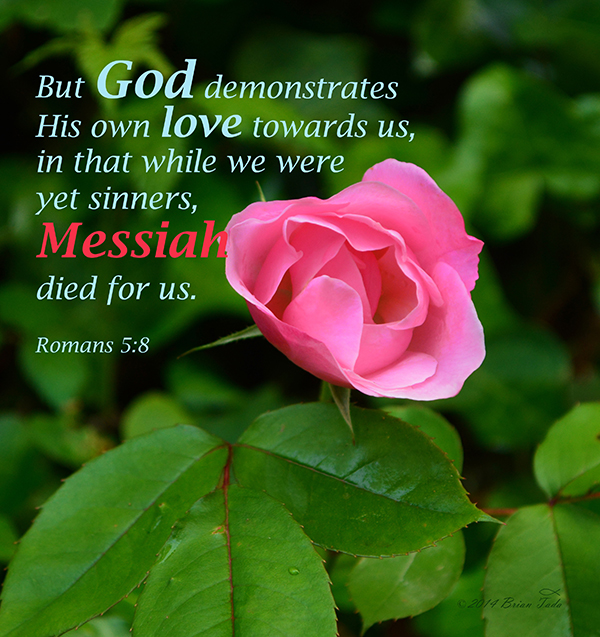
No Greater Love Rose Scripture @Brian Tada
Do you enjoy the photography or the editing more?
I enjoy both the photography and editing equally. For example, when out in the field, I love the excitement and the patience developed when photographing wildlife in their nature habitat. I focus on getting the best possible timing and composition. Then back home in the editing suite, I love being able to tweak my photos to present them as best I can to recreate for the viewer what I saw in real-life action.
Which other photographer, dead or alive, would you love to meet?
It would have been awesome to meet Ansel Adams. I admire the clarity and grandeur of his style of presenting the magnificence of landscapes such as Yosemite with such jaw-dropping excellence. I would have loved to pick his brain and learn about his thinking processes, preparation, technique, strategies and motivation to capture such amazing images on film.
What is your favourite piece of work by yourself?
Tranquility, hands-down. It is one of my best selling images on Pixels/Fine Art America, and it was also my very first artwork uploaded to my professional gallery there. Tranquility is my landscape photo of Redwood Creek gently flowing through the forest at Muir Woods National Monument just north of San Francisco. I added a painterly effect to my original photo. It looks absolutely stunning printed on metal, which is one of the options I offer for purchase in my gallery at PropheticPortraits.net
Tranquility @Brian Tada
How well do you take criticism?
There is a saying, “Feedback is the breakfast of champions.” I try to take constructive comments the best way I can, knowing that it is for my benefit and growth to learn and grow from them both personally and professionally. I believe “constructive criticism” is important to learn what others are thinking, and to see how I can improve and meet the needs of potential customers the best I can.
Come into Your Presence/I Worship You – The Music of Celebrant Singers
Do you travel far when photographing?
I travel both near and far to capture my photographic images. The closest is inside my home, photographing a montage of Mom’s multi-colored sewing spools. This still-life was honored as a finalist in the 2021 Fine Art America billboard contest.
The farthest I’ve traveled is Israel, where I took over 400 photos, some of which are featured in my portfolio at Pixels/Fine Art America. It was just amazing walking in the literal footsteps of my Savior Jesus and to relive the actual historic places where He walked and ministered.
I love to learn and to teach others what I’ve learned. I have written a college-level course curriculum entitled, “Healing and Health, God’s Way” for which I am grateful it has benefitted many people.
Have you tried drone photography yet?
No I haven’t yet. I do not have an interest in doing this kind of photography at this time.
What is your favourite personal photography story?
I have several. Most teach me lessons such as patience and perseverance. For example, on Valentine’s Evening 2016, traffic was backed up for miles along rural California Highway 37 in the San Francisco Bay Area. I decided to pull over at the nearest vista point to wait out the traffic. I noticed a beautiful sunset was forming, so I quickly set up my camera on a tripod I happened to have with me and waited. Just as the colors of the sunset were at their prime, I took several photos, one of which is in my gallery at PropheticPortraits.net and it is also one of my most popular and beloved photos. By the time I took the photo, the traffic had loosened up considerably and I was soon on my way home. I remarked to my mother who was with me that if I had been complaining and impatiently waiting through the traffic instead of pausing and contemplating the beauty of the sky, I would have missed out on one of the most spectacular sunsets I had ever seen! I learned a valuable life lesson from this photography story: Be willing to slow down and see the beauty around you. Relish the delicious lemonade from life’s lemons! The beauty is to share this experience with others so that they, too, may grow and benefit. This is one of the reasons why I do photography. It is more than an art form. It is a mission to transform and benefit precious lives.
Nice Threads @Brian Tada
Have you had exhibits in galleries?
The one that comes to mind is at a church in San Francisco, which displayed one of my photographic macro portraits of an orchid cactus blossom closeup. The flower’s stamens and petal textures were very clear and detailed. This image was developed from classic 35mm film and specially framed.
What was the best advice given to you as a photographer?
The best advice given to me as a photographer was ~ and still is ~ to have patience and to work consistently. It’s a marathon, not a sprint to get great photos. Realize that developing photography skills takes time and consistent practice. The rewards are worth it in the long run.
I am currently writing a faith-based book on mental health, wellness and recovery. Through my research and journaling (excerpts of which I will feature in my book), I have found that the average wait time a person struggling with mental health challenges endures before reaching out for professional help is 11 years. This is 11 years too long. I want my book to be even a small part of the much needed dialog on mental health, and to let people know that it is okay to talk about mental health and to seek help when needed. There are so many hurting people out there that need to know that they are not alone.
What advice would you give new photographers?
The advice I would give new photographers is the same. Have patience and be consistent in getting out there and taking pictures. Practice, practice, practice. And try new things in learning photography techniques. These are virtues that work with any photographic equipment and with any time period in history, including now and in the future.
Do you think the internet has altered the way photographers can get known?
I believe the internet has definitely impacted the way photographers can spread the word about their work. I think it’s both helped and hindered.
It’s helped to get your photographs seen if you use the available tools wisely such as a well-designed website, advertising through blogging, email lists, social media, etc. and search engine optimization via the prudent use of good photo descriptions, pertinent keywords, concise alt text, and so forth.
Valentine’s Sunset @Brian Tada
Conversely, I think the internet has hindered in that you are competing with so many other photographers. And the sheer number of photos online these days is just staggering. It’s like locating the proverbial needle in the haystack to find one of your photos. That’s where the wise use of promotional tools is so vital to be seen above the competition.
Have you done any courses to help you?
I’m mostly self-taught. I have taken a course entitled “Professional Photography” while I was attending Oral Roberts University in Tulsa, Oklahoma in the 1980s. That was during the days of film cameras. I worked in the darkroom, and it was amazing to see my black and white photos come to life on blank sheets of photo-sensitive paper after being exposed to light shining through the negatives and then developing them in the bath solutions. This experience has been invaluable in teaching me the basics of photography. This has instilled in me an appreciation for the essence of what photography is: “writing with light”.
Orchid Cactus Epiphyllum @Brian Tada
What do you do to market your work?
As Abbie Shores wisely said, uploading photos is half the work. The other half is marketing. I use social media to announce my new artwork, and I also write a blog connected to my Pixels/Fine Art America account. Recently, I had a booth at my church’s Festival of Joy Christmas crafts fair where I sold my FAA printed greeting cards and signed up several people for my brand new “Brian’s Art Newsletter” e-mail subscription (which was born out of my fair booth experience). I’ve found the in-person promotion of artwork is one of the best ways to promote one’s art. The personal connection fostered is invaluable.
Amazing Grace – Piano Instrumental Worship
Do you use social networking in your day to day life?
I primarily use Facebook to promote my work, and have found it has helped generate many sales from among my friends and followers. I also use Twitter, Instagram and LinkedIn. I’ve found every bit helps!
My work can be found at the following social media addresses:
It depends on the subject matter. I am very particular about this. I would need to know what it is about first, although I am open to consideration. It would be mostly faith-based artworks that I would be interested in doing if I were to do commissions.
Hovering Allen’s Hummingbird @Brian Tada
Have you got hobbies?
I realize the importance of hobbies as part of a well-rounded lifestyle. Mine include organic gardening, taking nature walks, organic cooking and reading.
What does your family think about what you do?
I am fortunate that my family is supportive of my photography artwork.
I’m a digital artist. My background is in Industrial Design. My interests include anything motorized, modern and futuristic architecture, space and sci-fi, jazz and especially abstract art. My objective is simple, to make something cool. I love experimenting in the digital world and hope my audience likes it too.
Since I was a youngster, my Dad would draw airplanes for me, so I followed suit, drawing cars.
Vaporizing Gold @David Manlove Art
What style of art do you use most?
Digital Abstract now. Prior to that, Industrial Design sketching and rendering, from rough thoughts to photo realism. Done mainly in marker and pastel. Then computers came along.
I don’t know that I really subscribed to any of the known “styles.” That is still a concept hard for me to grasp.
Has your style changed from when you first began as an artist?
Yes of course, one’s style evolves over time with new tools and techniques. The hope is that it’s a good evolution that people recognize.
Turbo Fachetti @David Manlove Art
What medium do you use?
I am currently all digital. A simulation of almost any medium is possible on a computer. Again, while I have favorite “looks” that a medium projects, I guess I attempt to simulate paint, strokes and the topographical nature of it on a surface. If that makes any sense.
How to get past the stigma associated with digital art. Because, that is ALL I do. I can’t even remember how to use a pencil. I don’t even use a stylus or graphics tablet. I’m strictly keyboard and mouse. And now with the onslaught of Ai. Sheesh. Digital art’s credibility feels even more diminished now. I jumped on Ai at first, but quickly faded on it, because it’s “not mine.”
What made you choose that medium?
I spent most of my art career working on a computer, so that’s what I’m used to. But simulating paint is an “assumption,” that I’m trying to let go of.
Mostly “re-imagining” life. Such as my latest Sun artworks. But of course, since abstract is my preference, I’d call that mostly imagination. Or perhaps neither, since I often tend not to have a predetermined vision in mind when I start a work. They turn out how they turn out, and it’s a “Wow I like that!” or “Shoot, that’s crap.”
Schools @David Manlove Art
How long does it normally take you to complete a piece?
I can complete several works a day on my computer but as with most art, it’s never really done, so I can spend days or more on multiple pieces at a time. I keep going until I like it.
Do you enjoy the creation of the piece (sketching out) or the finishing more?
I enjoy the “process” of a piece. An investigation, an experiment, and sometimes a happy accident. Finishing, is a necessary evil…
Do you work in a studio?
I don’t have a “studio” per se. I work at my computer in my bedroom.
Night of the City @David Manlove Art
Which other artist, dead or alive, would you love to meet?
There are too many to list.
Syd Mead (he’s passed now) was my idol when I was going to design school.
Harold Cleworth, for his photorealistic paintings of cars.
And, my favorite design instructor at school, Jack Zellner. He wowed us every time he picked up a marker (the tool of choice for designers)
These 3 are standouts for me. Funny how none fit my current direction and work. Although they influence everything I do really. I was never into art history, some of the famous abstract painters too.
What is your favourite piece of work by yourself?
The Great Oracle. I can’t even describe it or why I like it so much. Obviously an experiment gone right (or wrong depending on your point of view)
The Great Oracle @David Manlove Art
How much time (on average) does it take to complete a work?
As mentioned before, I can do several a day. Sometimes I’ll revisit and rework a piece. So, like a broken record, they’re never really done.
As hinted above, I am very self conscious and tend to struggle with my works relevance or credibility. My confidence is low and always think my work is not really that good. I take compliments as hard as criticisms because I rarely think my work is “all that.” So I often feel like people “just say that” to be nice. My definition of cool, isn’t the same as my audience. I guess.
How well do you take criticism?
I like to think I can take it if it’s constructive. I don’t deal well with detractors who simply scoff and badmouth, who speak with bias or ignorance. But, in design school, criticism is the norm. More affectionately known as critiques.
I don’t know. Sometimes I have to walk away for an extended period of time. Sometimes I just “do something” regardless if I have a vision or not, just to get over the hump of starting something. It’s “starting” that’s the key. Once you get going, it “happens.”
Arizona Brush @David Manlove
How do you know something is ‘finished’? Is it easy to walk away?
As you may have guessed from previous answers, I feel like my work is never really done. There’s always something more to do. Often though, that tends toward overdoing a piece. So sometimes I have to force myself to stop. There are times when I know too, that that’s it….done!
Minneapolis @David Manlove Art
Have you had exhibits in galleries?
I have never had any physical pieces in a gallery setting. Not that I couldn’t, but I have not pursued anything like that. Perhaps I should.
Have you any exhibits in galleries planned for the future?
None. I’m not a people person and my confidence is low. Nor do I want to make prints or have “inventory” to tote around. Talk about shooting myself in the foot.
C1.1 @David Manlove
What are you currently working on?
My latest effort has been producing Suns for CBS Sunday Morning. A U.S. based news documentary show airing every Sunday morning. I have had over 50 artworks chosen to air to date.
What are your plans for the future?
They say, if you fail to plan, you plan to fail. Well I don’t plan to fail but I don’t really have a plan. Other than, to keep making art (for now, Suns) I mean, does it make sense to plan? I’m more of a serendipity sort.
Fall On Fire @David Manlove Art
What was the best advice given to you as an artist? What advice would you give new artists?
None really “given” to me but I absorb a lot from other artists within Fine Art America and elsewhere. Especially, doing art for you (yourself, and what makes you happy). Give yourself a break and time to develop. Don’t be too hard on yourself, but we are our own worst critics. There is another side of that coin too, don’t be arrogant or condescending. I hate that.
I struggle with whether I’m wasting my time with any of this. That my art isn’t saleable. Who would want that on their wall? Who would ever pay me what I think it’s worth? Why do other artists make it big and others don’t? How do I stand out? Your a dime a dozen. Anybody can do what you do. And so on… And I believe them half the time, because I rarely even buy my own work. OOooof.
Do you think the internet has altered the way artists can get known? If so, is it easier or not? Has the internet made infringement easier etc?
Absolutely. If it weren’t for the internet and sites like Fine Art America, I would be nowhere. So, for exposure yes, it’s easier. And yes it’s easier to infringe or be infringed upon. It goes with the territory.
insaneintherainmusic – Luminaire (Insane In The Rain)
Windy City @David Manlove Art
Have you done any courses to help you?
I went to school for Industrial Design. Beyond that, I have not taken any extension art courses etc. Again, perhaps I should. I currently learn through my own trial and error, with art styles, techniques, software etc. While that tends to be slow and tedious, I think it helps me develop my own style without outside ques or influences, not that that doesn’t happen anyway. Pretty hard to not learn from others. As previously stated, the internet is all pervasive, thus more difficult to be unique.
What do you do to market your work?
Mainly social media and word of mouth. I also have business cards. Otherwise very little. However I do have my art with a licensing company. I’d rather they did the marketing. Many artists like myself feel we suck at marketing. A necessary evil. I’m trying out some new avenues on social media such as video slide shows with music (Reels, the equivalent of TikTok)
Yes and no, but one should really never say no. Yet, I tend not to simply because it’s much harder for me to work to someone else’s specifications.
Have you got hobbies?
Not really these days, my art is my hobby. Cars and motorcycles in my younger days.
Egyptian Sapphire Vertical @David Manlove Art
Do you have a significant other? Are they supportive?
I’m as single as they get. No significant other who could stand me. Art takes a lot of time in my head, so I use that for an excuse. So a fellow artist would be nice. The “whys” of being single are for another interview though, haha.
What do your family think about what you do?
My family is supportive. They think the CBS Sunday Morning stuff is really cool. They know art is my calling. They also know how hard it is to make a living at it.
Copper Radiation @David Manlove
What do you dream about when asleep?
Some really crazy sh*t. Even I don’t get it. A mish-mash of my past though. That’s probably fairly common. Nothing clairvoyant though. Yet.
My main focus is nature photography, especially flora and fauna that are naturally around my area in North Texas. In addition, I love to process my photographs with digital art effects. I also find that creating graphic art using effects, patterns and other techniques lend an artistic flair and is a fun and relaxing aspect of my photographic art.
I also enjoy pairing up my photographic art with Bible Scripture. My Photographic Scripture Collection is called ‘Faith-Devotional’ and is listed first in my Collections tab because I want to honor God first in all that I do in life and art.
I have slowly started to paint again which I haven’t done since the 1970’s. I have a few of my paintings and sketches in my collection and will have more as time allows.
When I was a little girl, about 5 years old, my dad would bring home cardboard sheets from work so I could draw on them. He was a watercolor painter/artist as a hobby and he encouraged me to draw and paint.
We had a small horse ranch and he also trained horses and taught English riding, jumping and dressage so naturally my drawing was of horses.
As I grew up, I did not keep up the art, except in high school. Then came family and career so this all was stifled down inside of me for many years.
I was gifted with a digital camera in 2010 and then a nicer one in 2012 and started to enjoy photography.
In the last few years, I have learned to use my photographs to process into digital art and graphic art, which I find has brought out the artistic ‘gene’ that was hiding in that little girl so many years ago.
What about photography in general?
God’s creation and nature has drawn me to look at the minute details of flowers and trees, so flower photography and art are what draws me in.
Which camera do you use most?
My Nikon D3100 was my go-to camera (which was gifted to me) and a few months ago it went kaput. My gracious sister had a barely used Nikon D3200 and gave it to me since she knows on my retirement income I could not afford another camera, so I now use that.
I love to study the bible and learn about how to love others and be kind always.
What made you choose that camera?
It was gifted to me and actually is a great camera.
Yes, I do. I use it to bring out tones and also if my images would look better as a digital painting I utilize it for that as well. I can create graphic art in it too.
Which editor do you love using most?
I have to use an affordable program so I use BeFunky. I have also used Photoscape and Pixlr for certain effects.
Do you enjoy the photography or the editing more?
I would say the editing more so because of the variety of art I can make from my images.
Which other photographer, dead or alive, would you love to meet?
Andrea Gulickx – her flower and macro photography is inspiring.
What is your favourite piece of work by yourself?
My white rose close up called ‘Dark Dramatic and Romantic White Rose’. I love the dark around it and the white of the rose petals seem almost illuminated.
Not intentionally, mostly in state, but in 2022 I had to be in California to help my sister take care of my elderly mother, so the traveling back and forth a few times gave me many photo ops.
Have you tried drone photography yet?
No, it would be fun to try though – I enjoy looking at drone photography and love the aerial views it produces.
What is your favourite personal photography story?
That my husband knows how much I love to take photographs and since I take my camera every time we leave the house, he will stop and be patient if I see something to photograph. He drives me everywhere because I have balance issues and can no longer drive a car for long distances, so the fact that he is willing and gracious to stop and let me take my time to get the shots I need is precious to me.
I was a horsewoman as a young lady and showed in Dressage and English riding/jumping – winning several championships in this field.
Have you any exhibits in galleries planned for the future?
No, I do not think I have the confidence to approach a gallery yet.
What was the best advice given to you as an photographer?
To learn the settings on your camera and don’t be afraid to mess up, they are digital after all and can be deleted. I would say to new photographers, the same – plus explore, experiment and enjoy it.
Do you think the internet has altered the way photographers can get known? Has the internet made infringement easier?
I think the internet is helpful for photographers to be found. Oh yes, I think it has made infringement much easier, I read the discussions regarding people who have found their images on other sites and the difficulties dealing with it.
Have you done any courses to help you?
Yes, years ago I attended a 3-hour basic photography course, and a few years ago one of my daughters gifted me with a Masterclass with Annie Leibovitz which was extremely good and well done.
What do you do to market your work?
I am in social networks and post images every day, I enter contests and now I am exploring the idea of donating my photographic art to charitable organizations.
I love animals but we don’t have pets at this time, since we live out in the country with no fences. We do, however, have neighbors dogs that come to our back door for treats, so that fulfils our animal fix for now.
I use social networks mostly in the morning hours. I have also joined the marketing group on FAA for promoting ourselves and others. Here are my social links:
No, I am not, unless someone wanted me to design a logo or graphic art piece.
Have you got hobbies?
Yes, walking, baking, and I like to make crafts with upcycling objects. I also like to sew felt Christmas ornaments for the holidays.
Do you have a significant other? Are they supportive?
Yes, my husband and I have been married over 47 years and he does support me and my photography and art. When I became ill with extreme vertigo in 2017 and now mild balance problems, he has taken care of me and will do anything to help me. He also will stop anytime while we are out if I see a photo op and he patiently waits for me while I shoot as much as need to. When I am in my home office and working on editing, he calls it my ‘Alternate Universe’ because I am so focused and quiet when working on the computer.
What do your family think about what you do?
They are very supportive and love when I share my photographic art with them. I make a ‘Family Calendar’ every year for them with my images and with everyone’s birthdays on each month.
What do you dream about when asleep?
Lately I have dreamt of my mother who just passed away in September. I dream a lot about the house I grew up in,
I dream a lot about the ocean and also flying in the air like a bird.
A recurring dream I have is finding shells on the beach or coins on the road or pretty rocks and stones.
Where are you based?
I am in north Texas in Nocona in the United States.


 Have you done any courses to help you?
 , copyright 2010, published in hardcover May 2010 by TOR. It is the concluding novel in my historical GEODYSSEY series.