
Hurricane Katrina Memories Part Three
This week I would like to share the three stages most people will experience when a disaster strikes. Please be advised that like grief, these stages can overlap and occur in almost any order. The order below is basically how I experienced these stages after Hurricane Katrina.
Stage One: Shock
As I mentioned in an earlier post my husband and I had driven over a 100 miles inland when we evacuated for Hurricane Katrina. We arrived there the afternoon before Katrina struck the Mississippi Gulf Coast and power was already out when we pulled into our friend’s driveway. Strong winds had downed power lines that affected their entire neighborhood and part of that town.
The next morning we stayed glued to the radio trying to get information about the situation on the coast as Katrina belted us with Category One winds (75-95 MPH) and heavy rain. We spent the next several days clearing our friend’s driveway and yard of tall, mature trees that had blown down.
The news of people being rescued by helicopters in New Orleans or of the survivors who were stranded at the stadium was shocking. It was frightening that there was no news of the Mississippi coast on the radio. We had no cell service so we were unable to call anyone who lived closer inland.
To say that we were shocked at what we saw when we were finally able to drive back to our homes is an understatement.
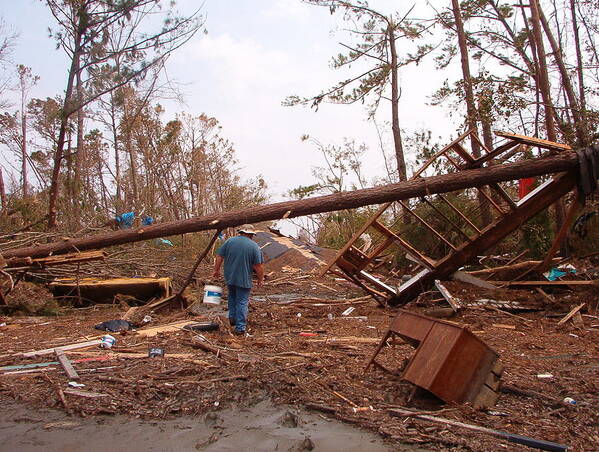
The first damaged structure that was visible from the main road was a commercial building that was now a mangled mess of steel beams. Steel beams literally bent, twisted and mangled together. No roof. No walls, nothing of substance left except the pieces of steel that had been the framing.
As we drove into town along US Highway 90 there were signs and light poles down everywhere, windows and doors to businesses were blown out and roofs blown off but the structures were still standing.
Entering our neighborhood we found our street blocked by downed trees and had to get out and walk through thick, sticky mud. When we rounded the corner to look down the road on our block we only saw what looked like mulch covering the road (it was bark that had been blown off of the trees) and the entire roof from our neighbor’s house. Climbing up on that roof only produced another roof in the road.
The view when we climbed over that second roof was unbelievable. I remember that I stood on the second roof and stared for a long time. There were no houses left on our street.
None.
Not one house anywhere on our street. Only slabs where our houses had been.
Most of the trees were gone. Not blown down just completely gone with only a big hole and broken roots where they had been lifted out of the ground and blown away.
It was hot and humid. I was tired from fighting that mud and climbing over debris but I wasn’t hallucinating. I knew that what I was seeing was real however my mind could not process the scene.
I was in shock!
Stage Two: Survival Mode
Survival Mode started immediately when we got back to our friend’s house inland.
Checking our cell phones constantly we pulled off the interstate when we got a signal and starting making phone calls. We made arrangements to go to Royce’s family in Georgia to regroup and recover somewhat. We could use a computer there to register with FEMA, notify State Farm and make temporary housing plans.
A travel trailer borrowed from a family member, set up on a co-worker’s property was our first housing solution. Survival there meant overflowing sewer hook-ups, extreme heat and a rock and roll night when Hurricane Rita blew through causing the trailer to move back and forth violently.
Our second housing solution was delivered on our mud and debris covered property compliments of FEMA. Royce barely survived physically after working all day then coming home to shovel mud, put up a power pole, run water and sewer lines to that FEMA travel trailer and pressure wash our concrete slab.
My days shortly after the storm were filled with visiting PODs (Point Of Distribution sites) to get toilet paper, paper towels, clothes, food, personal toiletries, bottled water and other survival items.
A rusted dryer drum found in the debris field across the street provided a safe place to burn the hundreds of branches we picked up while clearing our property. It also meant a warm spot on cool nights where we could gather and visit with friends giving us a somewhat sense of normalcy.
Normalcy. Even a small somewhat sense is very much welcomed in survival mode.
Reality Sinks In:
Several times during survival it hit me like a baseball bat on the side of my head that…
We had NO HOUSE. Yes, we had “housing” (a new, clean, dry travel trailer) and we were on our own property but that was temporary. How would we be able to rebuild when the insurance company was refusing to pay any of our claim, even the wind portion that we had paid for?
I had NO CAR. It flooded because I had left it on supposedly “high” ground there on the coast. A car had always been my sense of independence.
I had NO JOB. My office had been in our house and my broker’s office had been in his (now destroyed) house.
I fed the seagulls almost daily before the storm but now there were NO BIRDS or animals.
There were NO lights at night. It was really, really dark outside!
NO peace and quiet during the day. Sirens and helicopters overhead were heard daily.
These strikes of reality would come and go as I did whatever was needed to survive the heat, humidity and frustration of living in an area surrounded with total destruction and an overwhelming stench of rotten food and death.
Thank goodness that as the years passed we would find ourselves finally entering the recovery stage.
Stage Three: Recovery
It took Royce and I years to recover enough to move into permanent housing. I will give you a condensed timeline minus the stressful details of those recovery years.
We lived in the FEMA trailer for two and a half years. During that time the property underwent several landscaping projects in an attempt to get rid of all the mud and debris from our yard. My neighbor cleaned the mortar off the bricks from his former house and I hauled that mortar in a wheel barrel making hundreds of trips down the road from his property to our driveway, trying to get a hard surface to drive on instead of soft mud.
Knowing that those travel trailers were not safe during hurricane season the state of Mississippi delivered modular homes to replace the trailers. However, about six months after moving in to our Mississippi Cottage another storm put a small amount of water on our property and they took the cottage away. We were blessed to find a duplex to rent that was within walking distance of the beach.
We drove over to our property almost daily after Royce got home from work. We missed the view of the Bay. We missed our evenings around that rusted dryer drum. We missed our neighborhood.
It was during our time in that duplex, away from our “home” that we worked on planning our return. I drew out and designed a house plan and worked with a draftsman to get engineered plans. We had been saving every penny that was donated towards our recovery and applied for a state grant to help cover our rebuilding costs. We were on our way to returning to our neighborhood in a new home.
In August 2009, four years after Katrina, we moved into our new home. It was half the size of the home that Katrina destroyed but it was stronger and safer.
Life takes many strange turns sometimes and unfortunately we are not presently living in that paradise. But as I remember the trauma that I experienced from Hurricane Katrina, I also remember the blessings that came from many outside sources as well as our perseverance to survive and thrive after the storm.
Please join me next week for the final post before Katrina’s 20th Anniversary Date as I relate some of the life lessons that I learned during that time.
All of my public photographs of Hurricane Katrina’s aftermath can be found in the Photojournalism Collection on my site by clicking here.


Comments
What a heart breaking time that was for you!
Yes, it was, but it did get better!